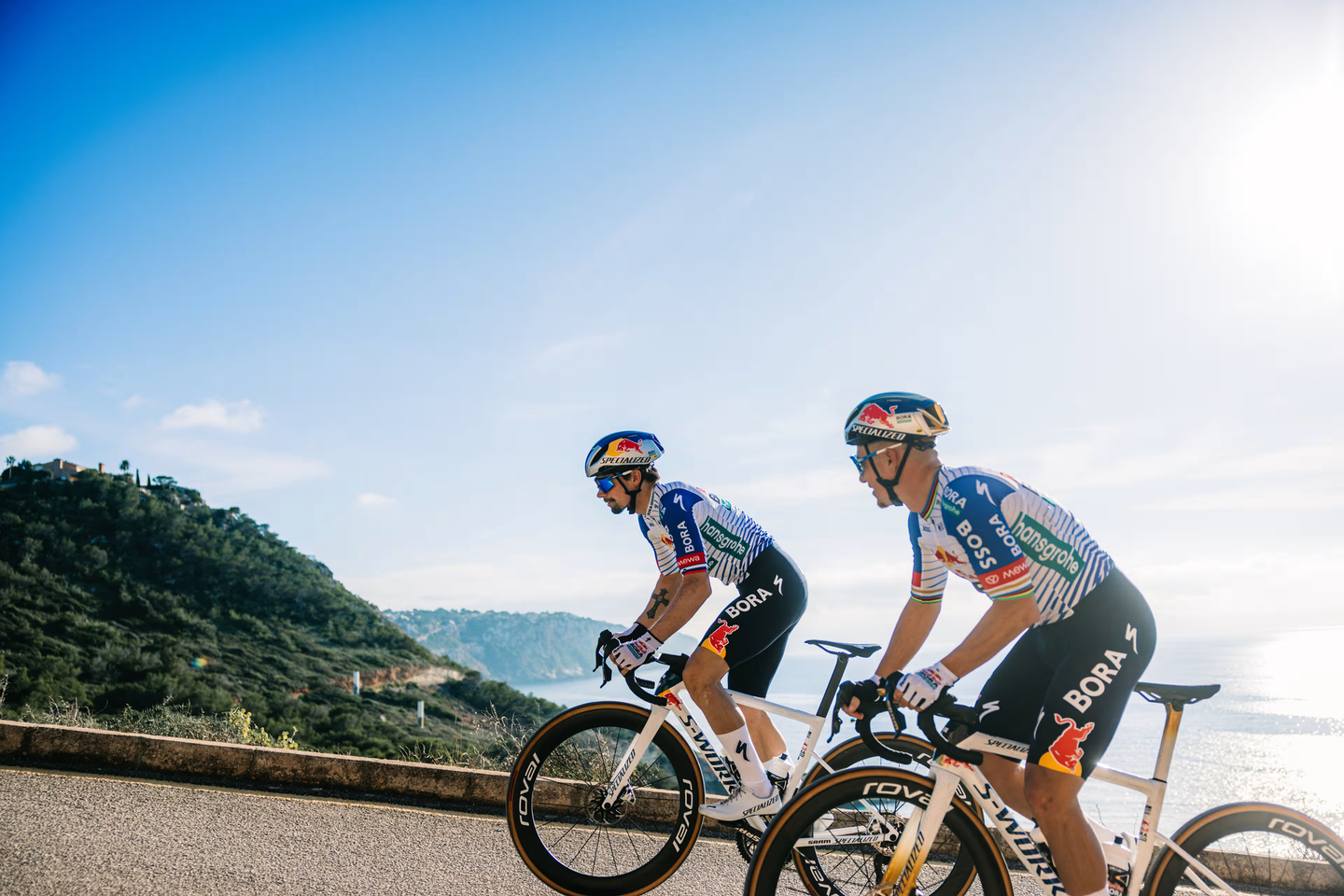
The Tour de France ended a month ago with Tadej Pogačar in yellow for a fifth time and every script followed to the letter. On Saturday, the same sport rolls out of Monaco looking like a different discipline entirely. La Vuelta a España is the third Grand Tour of the season, run over the same three weeks, with the same teams and many of the same riders. And yet nothing about it feels like July.
Ask any rider who has done both and they will tell you the same thing: the Tour is chess, the Vuelta is a knife fight. Understanding why is one of the best lessons in race dynamics, fatigue physiology, and pacing that endurance sport has to offer, whether you follow it as a fan or study it as an athlete.
Why Does La Vuelta Feel Different From the Tour de France?
La Vuelta feels different because it combines a fatigued late-season peloton, steeper and less predictable climbs, extreme heat, and looser tactical control. The Tour rewards disciplined, controlled racing by fresh teams at full strength. The Vuelta rewards opportunism, aggression, and the ability to perform on tired legs.
That is the short answer. The long answer runs through terrain, timing, physiology, and culture, and it explains why the Vuelta so often produces the most entertaining racing of the year.
How Does the Racing Style Differ Between the Two Races?
The Tour de France is the biggest bike race in the world, and that status changes how it is ridden. Every team arrives with its strongest possible roster, its season-defining objectives, and sponsors watching. The result is control. Sprint teams meter the pace of flat stages to the watt. GC squads set fortress tempo on the climbs to strangle attacks before they start. Breakaways are given a leash measured in seconds and reeled in on schedule.
The Vuelta operates under no such discipline. By late August, team objectives are partly settled. Some riders arrive to salvage a season, others to build form for the World Championships, others because a July crash or illness rerouted their calendar. The 2025 champion Jonas Vingegaard is a case in point this year: after breaking his collarbone at the Tour, he will not defend his title, and the entire tactical hierarchy resets.
With fewer teams committed to controlling the race, breakaways succeed far more often. Stage results become genuinely unpredictable. GC leaders attack each other on days that would be neutralized truces in July. The racing feels improvised because, compared to the Tour, it is.
Why Are the Vuelta's Climbs So Different?
The Tour built its legend on long, steady Alpine and Pyrenean passes: 15 to 20 kilometers at 7 to 8 percent, climbs where a strong team can set a sustainable tempo and defend a leader. Power output is high but relatively constant, which suits a controlled, threshold-style effort.
The Vuelta went a different direction. Spanish race organizers spent two decades hunting for short, savage, irregular walls: concrete goat tracks, ski station access roads, and ramps that pitch past 20 percent with no rhythm at all. On gradients like that, drafting means little, team pacing breaks down, and every acceleration is a violent surge far above threshold. It is repeated anaerobic efforts stacked on top of three weeks of accumulated load, which is a completely different physiological problem from riding tempo up a long alpine pass.
The 2026 route leans fully into this identity. The race packs roughly 58,000 meters of climbing into about 3,300 kilometers, with seven summit finishes including the Alto de Aitana, Calar Alto, Peñas Blancas, and the brutal Collado del Alguacil. For comparison, the Tour rarely exceeds five summit finishes. And the Vuelta does not wait: stage 4 in Andorra is just over 104 kilometers long with nearly 3,000 meters of climbing packed into it, an ultra-short, ultra-violent day that would be unthinkable in the first week of the Tour.
How Does Late-Season Fatigue Shape the Race?
The Vuelta is the third Grand Tour of the year, and that timing defines it physiologically. Riders arrive carrying six to eight months of racing load. Some are coming off the Tour with barely five weeks of recovery. Others have been managing form peaks since February.
Fatigue flattens hierarchies. A domestique who was anonymous in July can suddenly match the leaders in September because he absorbed less racing stress across the season. Young riders who skipped the Tour arrive fresher than the stars. Established leaders crack without warning on climbs they would have controlled comfortably in spring, because chronic training load and residual fatigue interact in ways that a single power test never reveals.
This is also why the Vuelta has become the redemption race. Riders whose seasons collapsed in July get one final chance to rewrite the narrative, and desperate riders race differently from comfortable ones. The result is a nervousness and aggression that the Tour's ruthless pecking order rarely allows.
What Role Does the Heat Play?
The Vuelta runs through the hottest part of the Spanish calendar in the hottest regions of the country. The 2026 edition doubles down on this: after opening in Monaco, France, and Andorra, the race funnels south along the Mediterranean and spends its final ten stages almost entirely in Andalusia, finishing in Granada in mid-September.
Racing at 35 degrees and above changes everything. Core temperature management becomes a limiter before muscular fatigue does. Sweat rates climb toward two liters per hour, and even small hydration errors compound across a five-hour stage. Teams run full pre-cooling and per-cooling protocols, ice vests, sodium-loaded bottles, and pacing plans built around thermal load rather than pure power. Riders who adapt well to heat routinely outperform their on-paper level in this race, and riders who do not can lose a Grand Tour in a single exposed afternoon.
For amateur athletes, the Vuelta is essentially a three-week case study in heat adaptation and thermoregulation under load, and the strategies the pros use scale down directly to age-group racing.
What Makes the 2026 Vuelta Edition Special?
The 81st edition, running from August 22 to September 13, has three storylines that make it arguably the most anticipated Vuelta in a decade.
First, Tadej Pogačar is riding it for the first time since his 2019 debut. Fresh off a record-tying fifth Tour de France victory, the Vuelta is the only Grand Tour missing from his palmarès. Win it, and he joins the tiny group of riders in history to have won all three. The Gran Salida in Monaco, with a 9.4 kilometer individual time trial, starts practically on his doorstep.
Second, Primož Roglič returns chasing a record fifth Vuelta title, which would make him the most successful rider in the race's history. His form is an open question after a training crash, which only adds to the intrigue.
Third, the route itself is an outlier. A foreign start in Monaco, four days across Monaco, France, and Andorra before the race even touches Spain, no visit to Asturias or Madrid, and an entire final third concentrated in the mountains of Andalusia. Two individual time trials, no team time trial, and a final week where the GC can flip on any of several summit finishes. With Vingegaard absent and Pogačar the overwhelming favorite, the real racing may be the wide-open fight behind him, with Roglič, João Almeida, Enric Mas, Mattias Skjelmose, Felix Gall, and Carlos Rodríguez all in the mix, while Mads Pedersen and Wout van Aert hunt stages.
What Can Age-Group Athletes Learn From La Vuelta?
Beyond the entertainment, the Vuelta demonstrates principles that transfer directly to age-group endurance racing.
Performance on tired legs is trainable. Vuelta riders produce their results on months of accumulated load. The lesson is not to race exhausted, but that managing chronic training load deliberately, rather than chasing freshness for every session, builds the durability that decides long races. Tracking load and recovery over months, the way Triforge Training Analytics does automatically from your Garmin, Wahoo, Suunto, or Strava data, matters more than any single workout.
Variable terrain demands variable training. The Vuelta's irregular ramps punish athletes who only train steady state. If your goal race has surges, hills, or pack dynamics, your intervals need to reflect that, with efforts above threshold and incomplete recoveries, not just clean, even blocks.
Heat is a skill, not a lottery. The riders who thrive in Andalusia in September prepared for it in July. Heat adaptation protocols, sweat testing, and sodium planning are among the highest-return interventions available to any endurance athlete racing in warm conditions.
Opportunism beats scripts when everyone is tired. In the final hour of a long race, the field is not fresh enough to control anything. Athletes who have practiced reading races and committing decisively, rather than waiting for permission, are the ones who take the results that fitness alone never guarantees.
FAQ
Is the Vuelta harder than the Tour de France? They are hard in different ways. The Tour has deeper competition and higher sustained speeds. The Vuelta has steeper climbs, more summit finishes, extreme heat, and arrives when riders carry a full season of fatigue. Many riders describe the Vuelta as the more physically unpredictable of the two.
Why does the Vuelta have so many summit finishes? Summit finishes create guaranteed GC action and television drama, and they suit the short, steep climbs Spain specializes in. The 2026 route includes seven summit finishes across its 21 stages, more than the Tour typically features.
When is the Vuelta a España 2026? The 2026 Vuelta runs from August 22 to September 13. It starts with a 9.4 kilometer individual time trial in Monaco and finishes in Granada after roughly 3,300 kilometers and about 58,000 meters of total climbing.
Is Tadej Pogačar riding the Vuelta 2026? Yes. Pogačar starts the 2026 Vuelta as the overwhelming favorite, riding the race for the first time since 2019. It is the only Grand Tour he has not won, and victory would complete the career set of all three.
Why is the Vuelta raced in such extreme heat? Its late-August to mid-September calendar slot places it in the hottest period of the Spanish summer, often in the hottest regions of the country. The 2026 edition spends its final ten stages in Andalusia, where September temperatures regularly exceed 35 degrees Celsius.
Want to train like a Grand Tour rider without a Grand Tour team behind you? Triforge AI Coach builds your plan around your real training load, adapts when life intervenes, and syncs with Garmin, Wahoo, Suunto, and Strava.