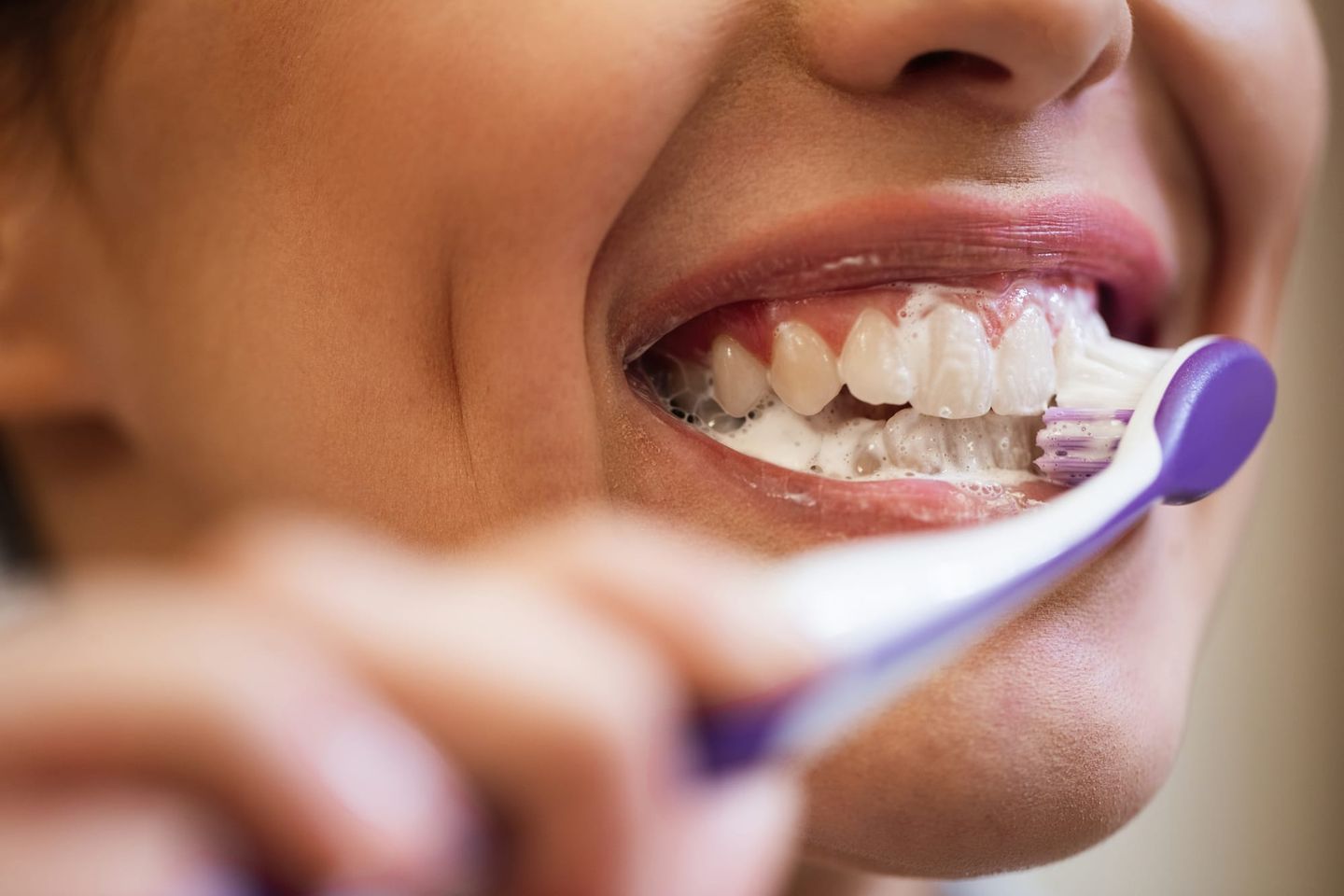
At UTMB, a race camera caught a runner stopped at an aid station in the dark, headlamp on, calmly brushing her teeth. Courtney Dauwalter does it several times across a hundred-mile race and calls it mental hygiene. The Wasatch 100 has an aid station captained by a local dentist who hands out pre-pasted brushes. Long-course triathletes tuck disposable brushes into special needs bags.
The habit is real and it is spreading. The explanation that travels with it usually is not. The most repeated version online claims that brushing clears enzymes from the mouth and unlocks faster carbohydrate absorption. That version is wrong in almost every particular, which is a shame, because the actual reasons are more interesting and considerably more useful.
What happens when you put mint and bristles in your mouth at hour seven involves a fast neural pathway, a thermoregulatory trick, and a taste receptor problem. One of those three effects can work directly against your fueling if you get the timing wrong.
Why do athletes brush their teeth during a race?
Athletes brush mid-race to reset a palate dulled by hours of sugar, to trigger a mint-driven cooling sensation that lowers perceived effort, and for a psychological reset that many describe as feeling like a shower. The effects are sensory and neural, not digestive. Brushing does not increase carbohydrate absorption.
Every athlete who has built this into a race routine describes it in the same register. It feels like a reset button. Dauwalter has said her legs matter in an ultra but the real key is in the teeth, which reads as a joke until you have gone eleven hours on gels and understand what a mouth feels like at that point. Salomon took her seriously enough to build a telescopic carbon toothbrush and a vest pocket sized to carry it.
The instinct is sound. The stated mechanism is where things go wrong.
Does brushing your teeth actually help you absorb more carbs?
No. This is the claim worth killing properly, because it gets repeated with confidence and it sends athletes chasing the wrong variable.
Carbohydrate absorption happens in the small intestine, not the mouth. Glucose crosses the intestinal wall through the sodium-dependent SGLT1 transporter, which saturates at roughly 60 grams per hour. Fructose uses a separate transporter, GLUT5, which is why combining the two opens a second lane and lifts the practical ceiling to 90 grams per hour and beyond with training. Gastric emptying sets the pace upstream of both. Those three things, transporter density, transporter saturation, and how fast your stomach passes fuel through, are the entire story of how much carbohydrate you can actually use per hour.
Salivary amylase does begin breaking down starch in the mouth. It is also irrelevant here for two reasons. First, almost nothing in a modern fueling plan is starch. Gels, drink mixes, and chews are built from maltodextrin, glucose, and fructose, which are either already simple sugars or need no oral processing at all. Second, salivary amylase is deactivated by stomach acid within minutes of swallowing. Removing it from your mouth changes nothing about what reaches your intestine.
There is no mechanism by which a toothbrush touches SGLT1, GLUT5, or gastric emptying rate. If you want more carbohydrate per hour, the lever is gut training, not dental care. The mouth is doing something else entirely.
What is the carbohydrate mouth rinse effect?
The mouth is not a digestive organ in any meaningful sense during a race. It is a sensor, and the signal it sends travels faster than any calorie you swallow.
In 2004, Carter and colleagues had cyclists rinse a carbohydrate solution and spit it out without swallowing a drop. Performance in a one-hour time trial improved anyway. Infusing glucose intravenously, which raises blood sugar identically, produced no such benefit. The effect was not metabolic. It was coming from the mouth itself.
What follows has been replicated many times. Carbohydrate contacting receptors in the oral cavity sends afferent signals to the brain, activating the insula, orbitofrontal cortex, and striatum, regions tied to reward, motivation, and motor drive. Imaging work shows that real carbohydrate lights up more of this circuitry than artificial sweeteners do, which suggests the brain is detecting the fuel itself rather than just the sweetness. Meta-analysis puts the typical performance gain at roughly two to three percent in efforts under an hour, and the American College of Sports Medicine includes mouth rinsing in its guidance for short high-intensity work.
This matters for the toothbrush question because it establishes the principle. Your brain is continuously reading the inside of your mouth and adjusting how hard the effort feels. Anything you put in there is an input to pacing, whether you intended it that way or not.
Why does mint change how hard a race feels?
Menthol is the most credible ergogenic ingredient in the toothpaste tube, and it works on a receptor that has nothing to do with taste.
Menthol activates TRPM8, a cold-sensitive ion channel in sensory neurons. Stimulating it produces the sensation of cooling without any actual drop in temperature. Because the oral cavity has a much thinner surface barrier than skin, mouth rinsing hits these receptors faster and harder than a topical spray. The signal travels via the trigeminal nerve to the hypothalamus and somatosensory cortex, and the brain responds as though the body has cooled down.
The performance data is real and specific. In a 5-kilometre treadmill time trial at 33 degrees, menthol mouth rinse improved finishing time while pre-race ice slurry did not, despite ice slurry being the intervention that actually lowered core temperature. Menthol reduced thermal sensation and ventilation without changing a single physiological variable. In a time-to-exhaustion protocol where the rinse was given at 85 percent of baseline exhaustion time, menthol extended the effort by 6 percent against 1 percent for placebo, statistically indistinguishable from ice ingestion.
That is the shape of the finding worth internalising. Perceived heat, not measured heat, is doing a large part of the pacing regulation in a hot race. Menthol lies to the thermostat. If you are racing in conditions that call for a full heat adaptation block, a mint rinse is a cheap addition to the same problem.
The caveat is that the evidence is strongest for isolated menthol at controlled concentrations, typically 0.01 to 0.1 percent, applied as a rinse. Toothpaste is not that. It contains menthol plus a lot of other chemistry, some of which cuts the other way.
What is flavour fatigue and why does a brush reset it?
Sensory-specific satiety is the formal name. After several hours of the same sweet profile, two things happen in parallel. Taste receptors adapt and become less responsive to repeated sweet stimulus. Separately, the brain builds an association between that flavour and the accumulating discomfort of the effort, which is a mild conditioned aversion.
The consequence is the single most common nutritional failure in long-course racing. The plan was 90 grams per hour. At hour six the gel is physically repulsive and intake quietly falls to 40. Nothing has gone wrong with the gut. The athlete simply cannot make themselves swallow another one, and the deficit compounds from there.
A toothbrush is a very aggressive palate reset. It mechanically clears the sugar film coating the tongue and teeth, floods the mouth with a completely novel flavour profile, and interrupts the sensory loop that built the aversion. Athletes who do this report that fuel becomes tolerable again afterwards. That is not a placebo. It is exactly what you would predict from sensory-specific satiety, which resolves when the stimulus changes.
The same logic explains why savoury food at hour six works, why rotating three to five flavours through an event beats loyalty to one, and why broth at a late aid station tastes like a miracle. The brush is the most extreme version of a strategy most experienced athletes already use in milder form.
Can toothpaste actually hurt your fuelling?
This is the part nobody mentions, and it is the reason timing matters more than the brushing itself.
Most toothpaste contains sodium lauryl sulfate, the surfactant that makes it foam. SLS does two things to your palate. It suppresses the sweet taste receptors on the tongue, and it breaks down phospholipids, the fatty compounds that normally dampen bitter perception. Suppressed sweet, amplified bitter. This is the entire reason orange juice tastes vile after brushing.
Now put that next to the mouth rinse literature. The oral carbohydrate effect depends on receptors in your mouth detecting carbohydrate and reporting it to the brain. If you have just coated those receptors with a sweet-suppressing detergent, you have temporarily reduced the sensitivity of the exact sensor that triggers the response.
The practical risk is not theoretical. Brush at an aid station, take a gel two minutes later, and you get a mouthful that tastes metallic and bitter rather than sweet. Athletes who have never heard of SLS interpret this as the gut rejecting fuel and stop fuelling. The gut had nothing to do with it.
So the brush gives you a palate reset and a menthol effect, but it also blunts sweet perception for a window afterwards. Those are not contradictory, they just need sequencing.
How to use this in a long-course race
Treat it as a scheduled intervention, not an impulse.
Brush in the last third, not the first. Flavour fatigue is the problem being solved, and it does not exist at hour two. In an Ironman that means the late bike or the T2 window. In a hundred-miler, the halfway drop bag onward.
Take your fuel first, then brush. Sequencing solves the SLS problem entirely. Consume the gel or the bottle, then brush, then allow the window to pass before the next feed.
Allow ten to fifteen minutes before the next sweet intake. Sweet suppression from SLS is temporary but not instant to clear. Plan the feed after the brush as a savoury one, or as plain water, and return to gels at the following interval.
Use SLS-free toothpaste if you want the cleanest version. It preserves the mechanical and menthol benefits without the taste receptor interference. Alternatively, brush with water alone and get the palate reset plus the mechanical clean without any surfactant at all.
Rinse hard afterwards. Water flow clears residual surfactant and restores normal taste faster.
Practise it before race day. Same rule as every other fuelling variable. The first time you test a mid-race brush should not be at kilometre 140 of an Ironman.
If you are building this into a race plan alongside fuelling intervals and heat strategy, Race Lab is designed for exactly that kind of scenario modelling, testing how execution decisions interact rather than treating each one in isolation.
Does race fuelling actually damage your teeth?
There is a genuine hygiene argument underneath all of this, even if it is not why most athletes brush.
A clinical evaluation of 278 athletes at the 2012 Olympics found dental caries in 55 percent of participants, erosion in 45 percent, gingivitis in 76 percent, and periodontitis in 15 percent. Around 18 percent reported that oral health had negatively affected their training or performance. These were Olympians, a population with better than average brushing and flossing compliance.
The mechanism is obvious once you look at a fuelling plan honestly. Hours of continuous sugar exposure in liquid and sticky form, in a mouth that is dehydrated and producing less protective saliva, is close to a laboratory model for enamel demineralisation. Ultra-endurance runners are among the most exposed populations there is, and research suggests they compensate through unusually high compliance with preventive dental care rather than through anything they do during the race.
The practical version: swish plain water after gels and sports drink to dilute acid and sugar, keep a dedicated rinsing bottle on long efforts, and consider a high-fluoride toothpaste if your training volume involves sustained carbohydrate intake. The mid-race brush is a nice extra. It is not the intervention that protects your enamel across a season.
Frequently asked questions
Does brushing your teeth mid-race improve carbohydrate absorption? No. Carbohydrate absorption is limited by gastric emptying and by the SGLT1 and GLUT5 transporters in the small intestine. Nothing in the mouth affects those. The benefits of a mid-race brush are sensory and neural.
Should I use toothpaste or just water? Water alone gives you the mechanical palate reset without any interference with sweet taste perception. Toothpaste adds a menthol cooling effect but also adds sodium lauryl sulfate, which temporarily suppresses sweet receptors. SLS-free toothpaste is the best of both.
How long should I wait to eat a gel after brushing? Ten to fifteen minutes is a reasonable buffer. Better still, take the gel before you brush and schedule the next feed after the window has passed.
Does mint actually improve performance or is it placebo? Menthol has repeatable effects in hot conditions through TRPM8 receptor activation, reducing perceived thermal strain and perceived effort without changing core temperature. The effect is perceptual rather than physiological, but the performance improvements measured in time trials are real.
When in a race is the best time to brush? The last third, once flavour fatigue has become a limiter. For an Ironman, the late bike or transition. For a hundred-mile race, from the halfway drop bag onward.
Can I use mouthwash instead of brushing? Mouthwash gives you the flavour change without the mechanical clearing of the sugar film, which is a meaningful part of the reset. Many alcohol-containing rinses also dry the mouth further. A brush with plain water outperforms most mouthwashes for this purpose.