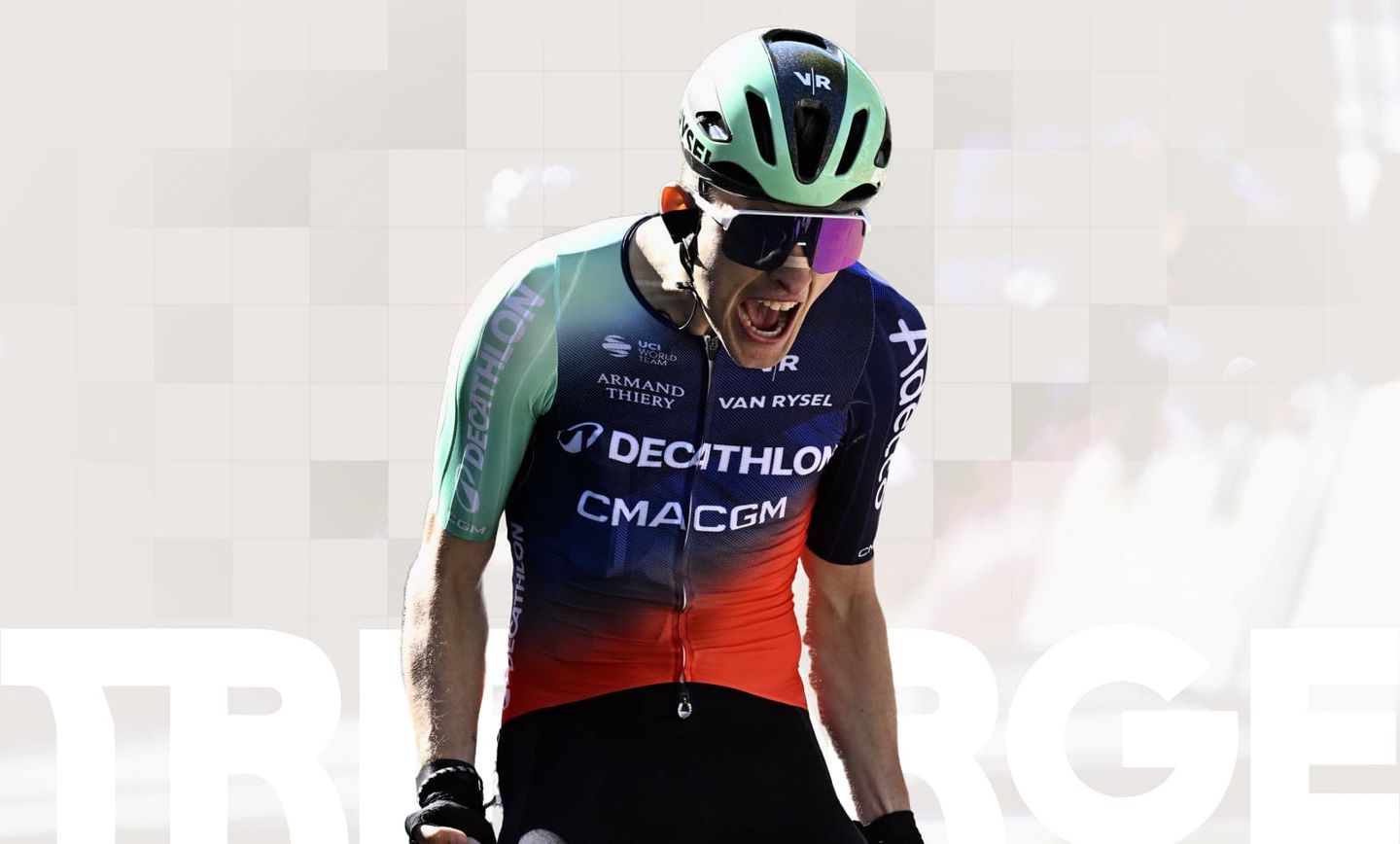
He turned pro at 17. He's already won more World Tour races in 2026 than most riders win in a career. And the question everyone's asking, will he ride the Tour de France this July against Pogačar and Vingegaard, is still officially unanswered. Here's what the data, the race footage, and the sport's insiders actually tell us about the most exciting rider since Tadej Pogačar himself.
There's a moment in every generational talent's story where the hype stops being hype and starts being evidence. For Paul Seixas, that moment arrived on the Mur de Huy on 23 April 2026.
With the Mur de Huy, 1.3km at a brutal average of 9.6% with ramps hitting 27%, rising ahead of him, Seixas set the third-fastest time in the race's history up that wall: 2 minutes 43 seconds. For context, only Alejandro Valverde in 2014 and Julian Alaphilippe in 2021 have gone faster up the Mur. Seixas was 19 years old. He was racing the Flèche Wallonne for the first time in his life. The year before, he'd watched it on television.
"Last year I was still watching this race on TV and now I win here, it is incredible," he said at the finish line.
That is the story of Paul Seixas in a sentence.
Who Is He?
Paul Seixas was born on 24 September 2006 in Lyon, France. He holds Portuguese heritage through his great-grandfather, and both his parents are high-level karateka, his father a vice-champion of France. It was his paternal grandfather, living in the Arve valley in Haute-Savoie, who first introduced him to cycling by watching the Tour de France on television. Wikipedia
He turned professional at 18, without passing through any development team, an announcement made by Decathlon-AG2R La Mondiale in September 2024 that sent a clear signal. According to L'Équipe, Seixas had 13 wins in 2024 and was being courted by every major team in the peloton.
At junior level, he won the junior Liège-Bastogne-Liège and both the national and world time-trial championships. In his first year as a senior professional, he finished third at the European Road Race Championships, behind only Tadej Pogačar and Remco Evenepoel.
That junior palmares alone would have been impressive. What followed in 2025 and the opening months of 2026 moved the conversation to a different level entirely.
What Makes Him Different
The cycling world talks about Seixas the same way it talked about a young Pogačar, with a mixture of disbelief and excitement. But what's actually happening physiologically and tactically that separates him from the pack of talented 19-year-olds who surface every season?
The power-to-weight profile. At 64kg and 1.86m, Seixas carries the height of a classic puncheur with a climber's weight. That anthropometric profile, tall, lean, long-leveraged, is unusual. Most elite climbers are significantly shorter. The combination gives him exceptional aerodynamic position on descents and flats while maintaining the watts-per-kilo ceiling needed to follow pure climbers on prolonged gradients.
The time trial engine. What truly marks Seixas as a potential Grand Tour contender rather than just a classics talent is his ability against the clock. At the 2026 Volta ao Algarve, he shed only seconds to the likes of Filippo Ganna and Juan Ayuso in the race's time trial. That kind of result, in his first full season of senior racing, signals a VO2max ceiling and lactate threshold that rivals the sport's established specialists.
The punch. The Flèche Wallonne victory confirmed what the Itzulia had already suggested: Seixas can win on explosive puncheur terrain that traditionally belongs to a completely different rider archetype. His ability to produce a massive short-duration effort at the end of a hard day, while already deeply fatigued, points to exceptional neuromuscular repeatability and an ability to operate at maximal intensity even under high blood lactate conditions.
The tactical intelligence. Cycling commentators described his Mur de Huy ride as "like a seasoned veteran, with the knowledge of his physiological data." He set a brutal tempo from the foot to fatigue every rival's explosive capacity, then attacked cleanly 200 metres from the line when nobody could respond. That's not 19-year-old improvisation. That's calculated race management. Eurosport
The attitude. When asked how he handles the pressure of expectations after winning stage 2 of the Itzulia Basque Country, he told TNT Sports: "I didn't hesitate to attack. The worst thing is being afraid to go for it. Racing like that is what I love, it's why I ride." That mental model, attack first, manage consequences second, is the same quality that defines Pogačar and, before him, every rider who dominated a generation.
The 2026 Season So Far: A Résumé That Defies His Age
In the space of ten weeks, Paul Seixas has assembled a race record that most professionals don't build in five seasons.
His first professional victory came at the 2026 Volta ao Algarve, where he took a summit finish at the Alto da Foia on Stage 2, holding off João Almeida and Juan Ayuso to take the stage.
Ten days later, he won the Faun-Ardèche Classic via a solo breakaway that covered more than 40 kilometres.
Then came Strade Bianche. He finished second behind Pogačar, the greatest rider of the current generation and arguably of all time, losing surprisingly little ground despite spending most of the final 79km either alone or at the front of a reduced group. On the white gravel roads of Tuscany, Seixas essentially confirmed that the gap between himself and the world's best is already measured in seconds, not minutes.
At the Itzulia Basque Country, he won the overall classification with three stage victories. He became the first French rider to win a World Tour stage race since Christophe Moreau in 2007. His vanquished rivals at the Basque Country included Florian Lipowitz, the rider who finished third at last year's Tour de France, as well as Isaac del Toro, Primož Roglič, and most of the established Grand Tour contender pool.
Then came the Flèche Wallonne. At 19 years and 210 days, he became the youngest winner in the race's 90-year history, winning on his first-ever participation. La-fleche-wallonne
By the time he raised his arms on the Mur de Huy, it was his seventh victory of the 2026 season.
Seven wins before the end of April, in just his second season as a professional, against the deepest field in the sport.
Why Everyone Wants to Sign Him
The teams reportedly pursuing Seixas's signature when his contract with Decathlon CMA CGM expires in 2027 include Red Bull–BORA–hansgrohe, INEOS Grenadiers, and Pogačar's own UAE Team Emirates–XRG. The fact that UAE wants another rider in the same mould as the rider they already have is perhaps the clearest possible statement of how rare this profile is.
Decathlon CMA CGM, however, is not a vulnerable team. A major funding boost when shipping giant CMA CGM joined on a five-year agreement raised the team's 2026 budget to approximately €40 million, placing them among the top five wealthiest WorldTour teams. They are French, their title sponsor is French, their star rider is French, and the Tour de France is French. The alignment is almost too neat.
Tour de France 2026: The Question Everyone's Asking
Will Seixas line up in Scotland in July against Pogačar and Vingegaard?
Seixas himself has said his second-half calendar is deliberately left open, with the team opting to monitor his form and adapt: "It will allow us to see how my form evolves, what I can really do, how to adapt." He is notably unflustered by the noise. "I don't really pay that much attention to it," he said of the Tour speculation. "I focus more on what I want to do, on what is best for my development above all."
France's national coach Cédric Vasseur has been unambiguous: "If I were the team manager, I'd put Seixas on the Tour de France 2026."
The debate within cycling media is real. One argument in favour is that 2026 is the only Tour de France Seixas will ever be able to race without crushing expectation, the logic being that if he rides well at the Vuelta first, he arrives at his Tour debut as a genuine GC contender, with no room to hide. The counterargument is straightforward: the longest race he has ever completed is eight days. Throwing him directly into a three-week Grand Tour against Pogačar and Vingegaard — while bypassing the Giro or Vuelta entirely, carries real developmental risk.
The honest answer is that no one outside the Decathlon CMA CGM team room knows for certain. But the fact that the conversation is even happening, that a 19-year-old who has never ridden a Grand Tour is being seriously discussed as a potential podium contender at the Tour, tells you everything about the scale of what Seixas is doing.
The physiological ceiling for a rider of his profile is almost impossible to define right now, because he is still growing into it. What is already visible, the climbing legs, the time trial engine, the puncheur sprint, the tactical composure, is the complete package. The question is not whether Paul Seixas will one day win the Tour de France. The question is when.
The Bigger Picture for Endurance Athletes
For athletes tracking performance data, whether you're a competitive age-group triathlete or a serious cyclist, the Seixas phenomenon offers a useful lens.
His success is not just about raw talent. The deliberate, structured programme his team has built around him, choosing races that develop his strengths, leaving calendar flexibility to adapt, refusing to rush him into the sport's biggest stage before he's ready, mirrors the principles that underpin any well-designed long-term training plan. Progressive overload. Specificity. Recovery. The willingness to resist short-term pressure in favour of long-term adaptation.
The parallels to endurance training science are not accidental. The best coaches in professional cycling and the best coaches in triathlon are working from the same physiological principles. Seixas is the outcome of applying those principles without compromise.
Whether he lines up at the Tour this July or not, one thing is already settled: Paul Seixas is the most exciting young rider in professional cycling, and this is only the beginning.