
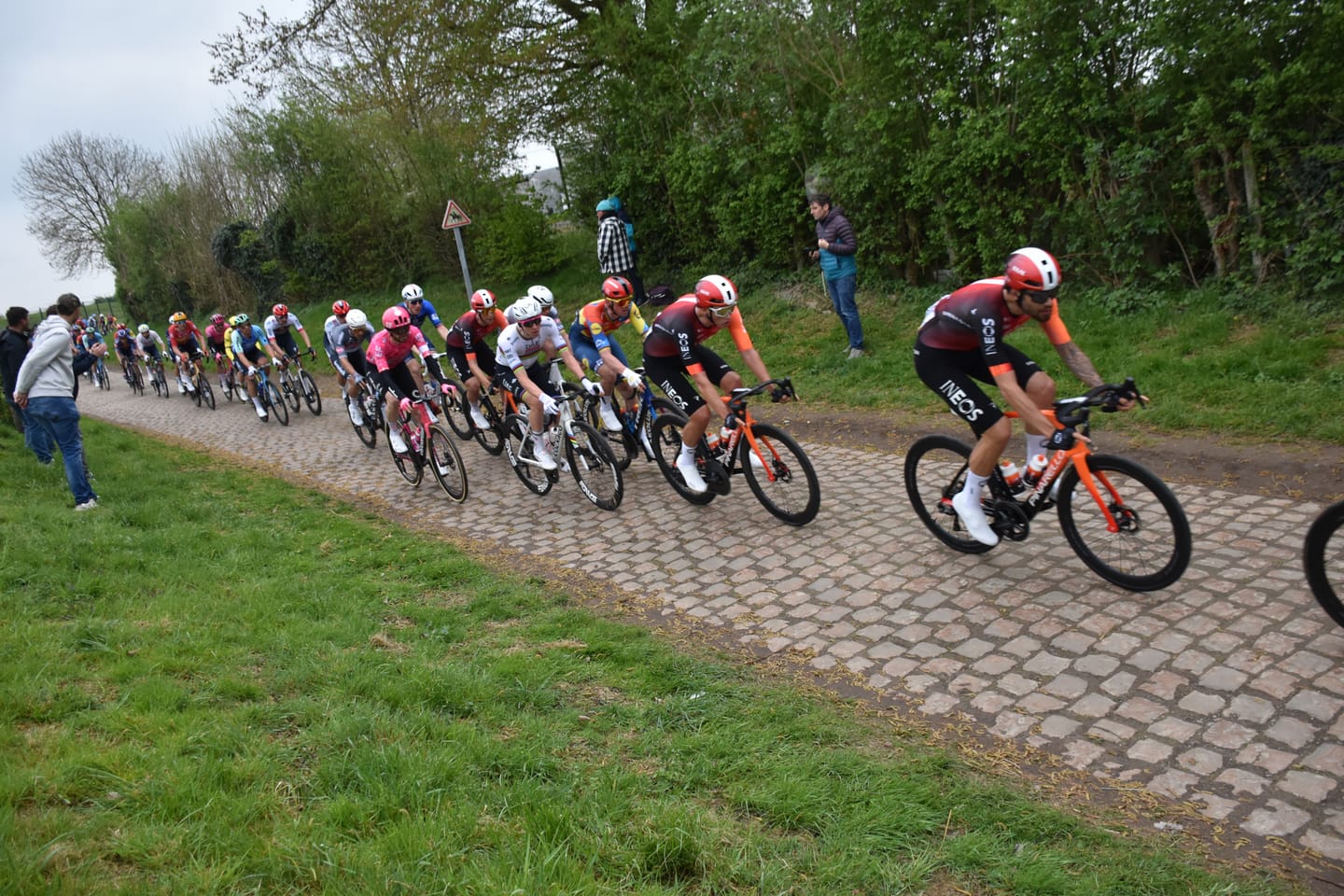
April 12. Compiègne to Roubaix. 258 kilometres. 54.8 kilometres of cobbles. One winner.
Paris-Roubaix is not a bike race that rewards elegance. It rewards raw power, technical precision under fatigue, the ability to absorb punishment across six or seven hours of racing, and, perhaps more than anything else, luck. The 123rd edition, taking place on Sunday April 12, 2026, features a field good enough to produce a classic finish and a route that has been modified to guarantee the carnage starts earlier than ever.
Here is everything you need to know about one of the greatest spectacles in professional cycling.
What Changed in 2026, And Why It Makes the Race More Dangerous
The headline route change for 2026 is deceptively simple: the opening cobbled sectors have been rerouted slightly east toward the village of Briastre. The practical effect is significant. The first four cobbled sectors now follow one another in quick succession with almost no tarmac between them, creating an unprecedented density of pavé in the early race. Escape Collective
Race director Thierry Gouvenou explained the logic: "By veering slightly east towards the village of Briastre, we arrive at a situation where the first four sectors follow one another in quick succession, with almost no asphalt in between. Two years ago, Alpecin-Deceuninck had already begun to scatter the peloton at this stage. And at the end of this sequence, we are adding sector 26, even more rarely used and featuring an 800-metre climb." Yahoo!
Historically, the opening cobbled sections were survivable. A puncture or crash in the first hour was recoverable, the decisive racing was still far ahead. In 2026, that buffer disappears. Getting caught behind a crash or suffering an early mechanical in the first sectors could cost riders significant time before the peloton even reaches the infamous Trouée d'Arenberg. BikeTips
The final 20 sectors, including Arenberg, Mons-en-Pévèle, and the Carrefour de l'Arbre, remain unchanged from 2025. Paris-roubaix The route's brutal conclusion stays intact. What 2026 adds is a more brutal beginning.
The total distance is 258.3 km with 30 cobbled sectors accounting for 54.8 km. Paris-roubaix The women's Paris-Roubaix Femmes runs on the same day, the first time both races finish at the Roubaix velodrome on the same afternoon, and features the most cobbles in the women's race history. Paris-roubaix
The Sectors That Decide the Race
Roubaix's cobbled sectors are rated from one to five stars. Most of the race is decided in the final third, but the 2026 modifications mean the early sectors carry genuine selective weight for the first time in years.
The early sequence, Troisvilles to Solesmes (roughly km 96–120) The new routing creates a sustained block of pavé with minimal recovery tarmac. This is where the peloton will split for the first time. Teams need to be positioned at the front before this sequence begins, a task that, with 190+ riders, generates its own chaos.
Trouée d'Arenberg, 5 stars, 2,400m (km 161) The most iconic sector in professional cycling. A straight, tree-lined stretch through a forest, rough camber, enormous crowds pressed against the barriers on both sides. Riders enter at speed and have to hold a line for 2.4 km of some of the worst cobbles on the course. Crashes here are frequent and often race-ending.
Mons-en-Pévèle, 5 stars, 3,000m (km 210) The longest of the five-star sectors. By this point in the race, legs are compromised, bikes are degrading, and the peloton has usually broken into small groups. This is where the definitive selection often happens.
Carrefour de l'Arbre, 5 stars, 2,100m (km 241) The last major difficulty. Seventeen kilometres from the velodrome. By the time riders reach the Carrefour, only a handful of riders, sometimes just one, remain with a genuine chance of victory at the velodrome. Paris-roubaix This is where Roubaix is won and lost.
The Contenders
Mathieu van der Poel, Chasing History
Van der Poel is the three-time defending champion and will be aiming to join Roger De Vlaeminck and Tom Boonen on a record-equalling four victories. Domestique Cycling He has dominated this race with authority, his cobble instincts, power, and positioning are unmatched in the current peloton.
He won E3 Saxo Classic for a third consecutive year in a tactical masterclass Rouleur and appears in strong form heading into the final two Classics of the spring. His Alpecin-Deceuninck team has recorded back-to-back 1-2 finishes at Paris-Roubaix in 2023 and 2024 Cyclist, with Jasper Philipsen providing both sprint insurance and a formidable lead-out option.
The case against: nobody wins Roubaix four times in a row. The race will be designed to stop him, and the field arrayed against him is the strongest in years.
Tadej Pogačar, The Revenge Mission
Pogačar's 2025 Roubaix debut was extraordinary and painful in equal measure. Race debutant Pogačar stayed on terms with Van der Poel into the finale but then faded to second after misjudging a turn and having an ungraceful crash with 40 kilometres to go. Cyclingnews
He has since committed to the race with an intensity unusual even by his standards. In December, Pogačar visited northern France to conduct equipment tests on the cobblestones, and four days after his victory in Strade Bianche, he returned to explore all the cobbled sectors with Florian Vermeersch, covering 210 kilometres in total. Cyclingflash
The bike setup tells its own story. Confirmed by his mechanic, Pogačar will race aboard Colnago's aero machine with Continental GP5000 S TR tyres pushed to what appears to be the 35mm variety, so tight there's almost no room between tyre and fork. Cyclingnews He is leaving nothing to chance.
Paris-Roubaix remains one of only two Monuments absent from Pogačar's palmares, and after winning Milan-San Remo earlier this spring, it is now the one that looms largest. The pure cobble demands, sustained vibration, technical positioning at high speed, the specific neuromuscular punishment of rough pavé, differ from the power output and climbing that have made him untouchable elsewhere. But he knows the course now, and he has the machinery and teammates to compete.
Wout van Aert, Form Returning at the Right Time
Van Aert's 2026 began terribly. A fractured ankle in cyclocross in January, illness, crashes, and mechanical misfortune through the early classics had written a narrative of a season unravelling. Milan-San Remo rewrote it.
When Van Aert came down in the crash ahead of the Cipressa at Milan-San Remo and had to wait longer than anyone for a new bike, few gave him a chance. But he fought back to the main bunch on the Cipressa and in the closing kilometres used a spur-of-the-moment decision to sneak away and take third place. Cyclingnews
The performance signals form returning at exactly the right moment. Van Aert's Roubaix record is strong, fourth in 2025, and Visma-Lease a Bike have assembled supporting cast including Matthew Brennan, who made an impression at last year's Roubaix despite a late call-up, rubbing shoulders at the head of the race. Cyclist
Mads Pedersen, The Injury Comeback
Pedersen's spring was thrown into doubt in February when fractures from a crash at the Volta a la Comunitat Valenciana and subsequent surgery raised questions about whether he would race Flanders or Roubaix at all. Escape Collective
He answered those questions at Milan-San Remo, sprinting to fourth on the Via Roma only six weeks after surgery, a performance that confirmed he is very much a contender for the rest of the Classics. Escape Collective Pedersen has finished on the Roubaix podium twice in the past two editions, always behind Van der Poel. If his wrist holds, he is dangerous. The Dane won Gent-Wevelgem in spectacular fashion last year with a 56km solo attack Rouleur, he is not a rider who waits for races to come to him.
Wildcards Worth Watching
Filippo Ganna, The Italian time trial specialist has targeted Roubaix seriously. Ganna returns to the cobbles hoping to make amends after missing the moves at Milan-San Remo, with Paris-Roubaix as his next big goal of the season. Rouleur His power on the flat, combined with a team that can control the race, makes him a threat in the finale.
Jasper Philipsen, Operating in Van der Poel's shadow, but Philipsen is arguably the best pure sprinter in the race. If Van der Poel can deliver him into the velodrome with company, a Alpecin-Deceuninck 1-2 is very much in play.
Florian Vermeersch, Not an outsider; a genuine threat. The UAE Team Emirates-XRG domestique who completed the Roubaix recon alongside Pogačar knows the course as well as anyone in the field.
What Roubaix Actually Demands, A Performance Perspective
For endurance athletes watching Paris-Roubaix, the physiological picture looks deceptively familiar, big aerobic engine, high sustained power, ability to operate at threshold for extended periods. All of that is necessary, but none of it is sufficient.
What separates Roubaix is the neuromuscular cost of cobbles. Riding rough pavé at race pace imposes constant micro-perturbations on the musculoskeletal system. Maintaining forward velocity requires continuous micro-corrections, hands, core, upper body absorbing and redirecting force that would be absent on tarmac. The metabolic cost of maintaining a given power output on cobbles is substantially higher than the same power on smooth road. Research on vibration and cycling economy consistently shows that rough surfaces increase perceived exertion and oxygen consumption at equivalent workloads.
Tyre selection translates this directly. Elite teams now run 30–32mm tubeless tyres at very low pressures, often 3.5–4 bar, which gives significantly better cobble compliance. BikeTips Wider, lower-pressure tyres deform around the cobble surface rather than bouncing off it, converting vertical energy into forward motion rather than rider fatigue. Pogačar's apparent push toward 35mm pushes this principle to its limit given his bike geometry.
The race also demands something that interval blocks don't develop well: the ability to handle a bike at high speed on unpredictable, variable-grip surfaces while fatigued, in a tight peloton, after six hours of racing. This is the skill Van der Poel has refined across decades of cyclocross, mountain bike, and road racing. It is the skill Pogačar has been building through methodical recondition trips, equipment testing, and deliberate preparation.
Power and fitness get you to Arenberg. Everything after that is something else.
April 12
Paris-Roubaix does not disappoint. BikeTips This edition, with the densest early-sector opening in the race's modern history and the sharpest field assembled in years, has the ingredients for something memorable. Van der Poel chasing a record-equalling fourth win. Pogačar chasing the one Monument that has escaped him. Van Aert rediscovering himself. Pedersen proving the wrist holds.
Set the alarm. The race rolls out of Compiègne at 10:00.