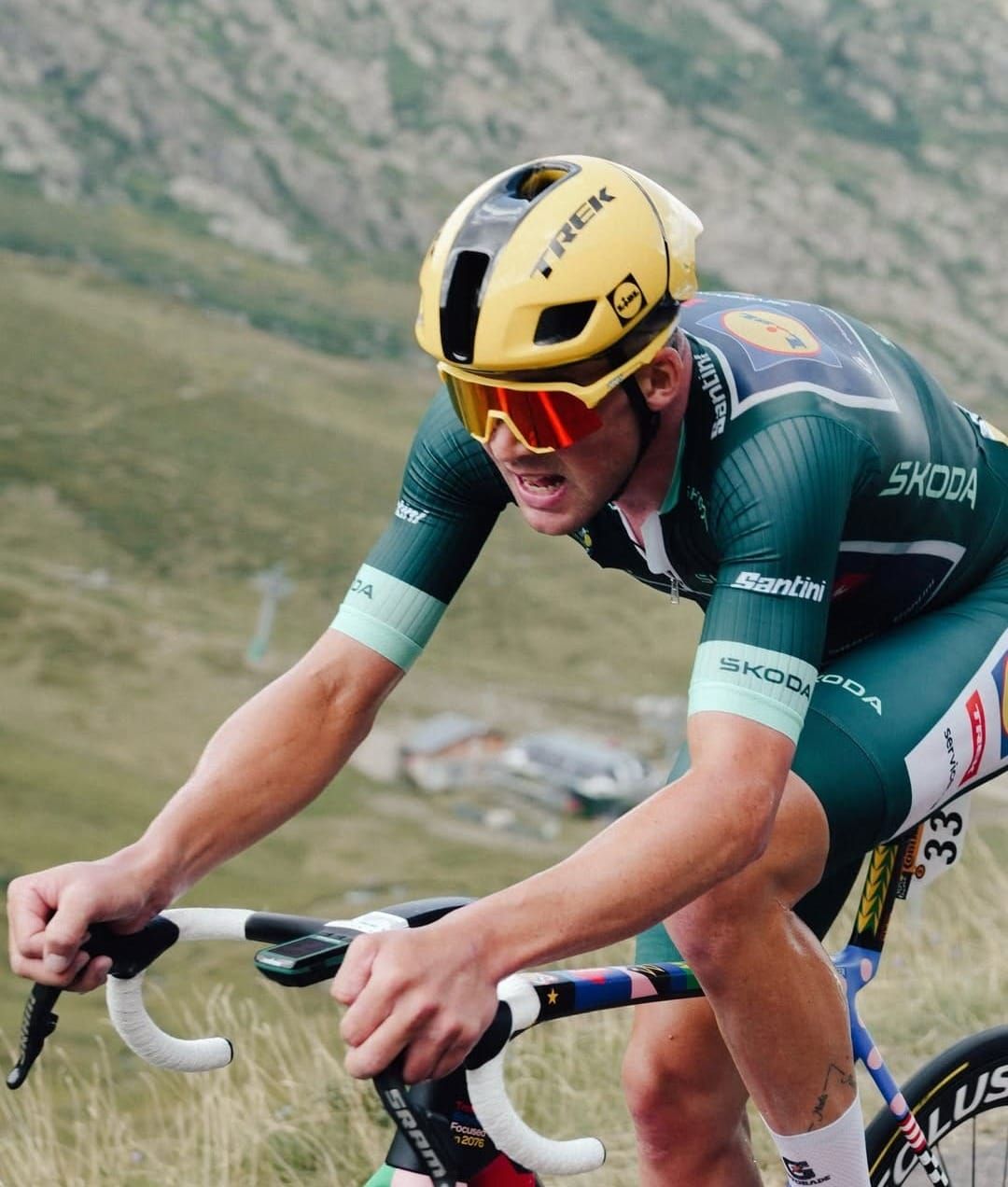
The 2026 Tour de France points classification is decided. On the hardest stage of the race, a 170.9-kilometer queen stage packing roughly 5,600 meters of climbing into the road between Le Bourg d'Oisans and Alpe d'Huez, Mads Pedersen attacked out of the yellow jersey group on an hors categorie climb, bridged across to the day's breakaway, and took maximum points at the intermediate sprint. That haul pushed his lead over Jasper Philipsen to 72 points with only the processional finale in Paris remaining. The green jersey is mathematically his, provided he rolls across the line on Sunday.
It is a fitting way to seal it. Pedersen has not won this classification by outsprinting the fastest men in the world on flat boulevards. He has won it by being strong enough to go where they cannot, day after day, for three weeks. And if you want to understand how a rider built like a Classics specialist survives the Pyrenees, the Massif Central, the Vosges, the Jura, and three brutal Alpine stages while still contesting points almost every day, the answer is sitting in plain sight in the numbers his coach shared earlier this year.
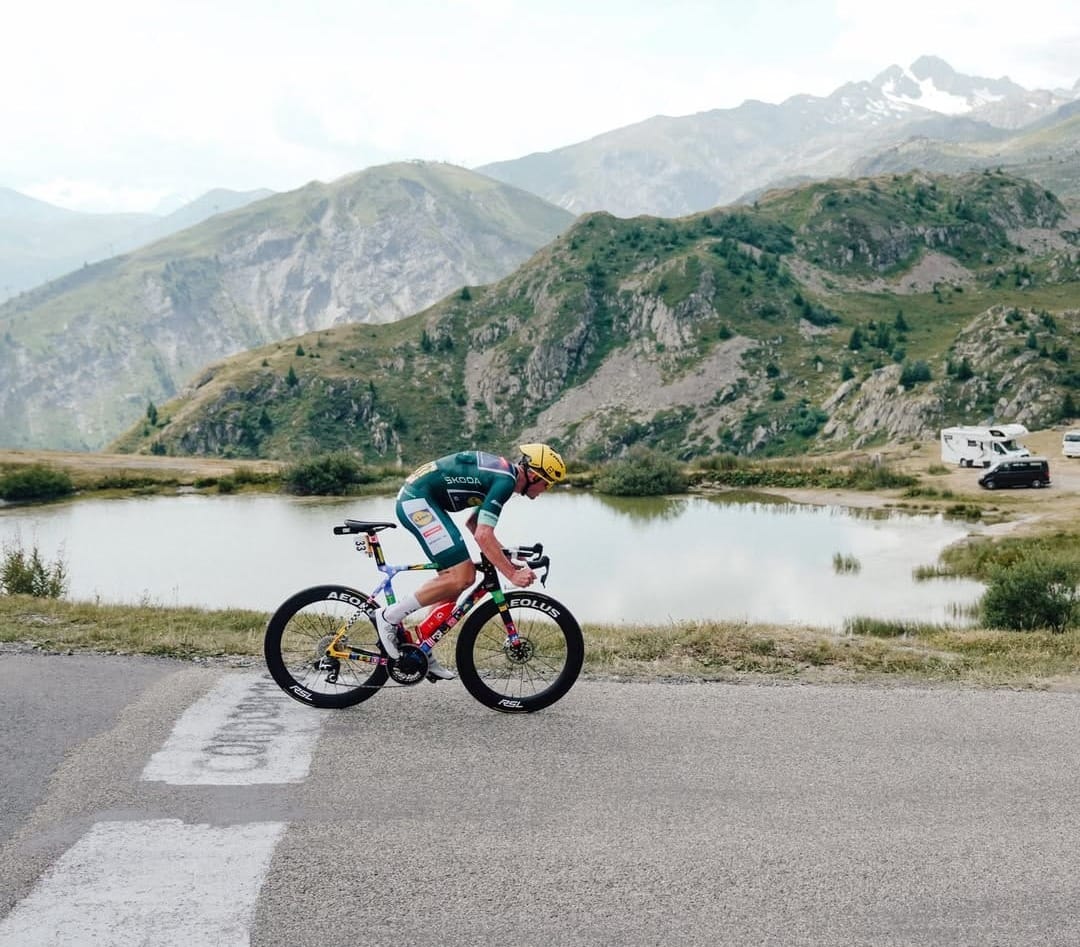
How Did Mads Pedersen Win the 2026 Green Jersey?
Pedersen won the 2026 points classification by targeting intermediate sprints from breakaways on stages too hard for pure sprinters, rather than relying on bunch finishes. His stage 4 victory in Foix launched the campaign, intermediate sprints supplied the majority of his points, and a final attack on the Alpe d'Huez queen stage sealed a 72-point winning margin.
That single paragraph hides a tactical masterclass. The 2026 route was front-loaded with mountains and kept heavy through the middle week, which meant the pure sprinters, riders like Tim Merlier, Olav Kooij, and Philipsen, had fewer clean opportunities to bank their trademark 50-point stage wins. Pedersen and Lidl-Trek read that route perfectly. Rather than conceding the sprint stages and hoping to survive, they turned every awkward, lumpy, in-between day into a points harvest.
The pattern was established early. On stage 4 from Carcassonne to Foix, a day too selective for the fast men to control, Pedersen rode the winning breakaway and finished the job ahead of his own teammate Quinn Simmons. That win handed him the jersey and a points cushion he would defend for the next two and a half weeks. From there, the campaign became a study in relentless accumulation: by the end of the first twelve stages, intermediate sprints alone had supplied 218 of his points, roughly 61 percent of his total. Many of those sprints were taken from breakaways on hilly terrain, exactly the kind of stages where his rivals were sitting in a grupetto conserving energy.
Was the Green Jersey Ever in Danger?
Yes, and more than the final margin suggests. Philipsen's stage 17 victory in an explosive sprint finish cut Pedersen's advantage to single digits, and the Dane admitted afterward that he briefly thought the fight was over. What followed was arguably the defining 72 hours of his Tour.
On stage 18 to Orcières-Merlette, a genuine mountain stage, Pedersen forced his way into a breakaway alongside climbers like Richard Carapaz and Valentin Paret-Peintre, survived the elevation, and collected another 25 points at the intermediate sprint. His lead grew from 7 points back to 32. He repeated the trick on stage 19. Then came stage 20, where he attacked on an hors categorie climb while sitting on a 57-point lead he could plausibly have defended passively. He chose not to. He bridged to the break, took the full 25 points, and closed the argument.
That sequence, three consecutive days of aggressive point-scoring across the hardest terrain of the race, is not something a rider improvises in week three of a Grand Tour. It is the visible output of a training foundation built months earlier. Which brings us to the most interesting part of this story.
What Does Pedersen's Training Actually Look Like?
Pedersen's coach, Lidl-Trek head coach Mattias Reck, pulled back the curtain on the Half Wheeling podcast this spring, and the numbers he shared reframe everything about how this green jersey was won.
Pedersen logs between 1,100 and 1,200 hours of training per year. For context, that figure sits at the extreme upper end of what WorldTour professionals sustain, and Reck has noted that hitting it while racing a full calendar and traveling constantly requires many weeks of around 30 hours on the bike. Most professional riders average closer to 20 to 25 hours in big weeks and considerably less across a full season once racing, travel, and recovery blocks are accounted for.
The most revealing episode came after Pedersen's crash on the opening stage of the Volta a la Comunitat Valenciana in early February, where he fractured his wrist and his collarbone on opposite sides of his body. His spring campaign, the cobbled Classics he leads Lidl-Trek into every year, was suddenly in jeopardy. Because his legs were largely unhurt, the response was not rest. It was volume.
A few weeks after the crash, Pedersen traveled to a team camp in Mallorca and trained 80 hours in two weeks. The first week, still unable to ride outdoors safely with his injuries, he spent entirely on the rollers: 37 hours indoors in seven days. And these were not passive recovery spins. The structure included interval sessions of three hours in the morning and three hours in the afternoon, six days running, with a one-hour recovery ride wedged between the two daily blocks.
Reck has been direct about how unusual this capacity is. He has said it took him years to realize how much training Pedersen can genuinely handle, describing the workload as almost crazy when laid out on paper. The critical detail, though, is not the volume itself. It is the physiological signature underneath it: Reck has observed that when Pedersen trains too little, his heart rate runs high and his power output drops. His body does not merely tolerate enormous load. It appears to require it to function at its best.
The gamble paid off almost immediately. Pedersen came out of that compressed indoor block better than expected at Dwars door Vlaanderen and stronger again at the Tour of Flanders, where he finished fifth despite the disrupted build. The same engine then carried him through July.
Why Is Recovery Capacity the Real Story Here?
The instinct when reading numbers like 1,200 hours a year is to focus on the training. The more useful lens is the recovery.
Training load only becomes fitness when the body absorbs it. Chronic training load, the rolling long-term average of work an athlete sustains, is the metric that actually predicts durable performance, and it can only climb as fast as recovery allows. What separates Pedersen from riders who would be buried by a 30-hour week is not willpower or pain tolerance. It is the rate at which his physiology converts stress into adaptation and resets for the next day.
This is the same quality that defines his racing. The green jersey campaign demanded near-daily efforts: breakaway entries, intermediate sprint accelerations, survival climbing, and repeated deep digs with no true rest days between them. A rider who accumulates fatigue faster than he sheds it cannot attack on the Croix de Fer in week three. Pedersen could, because the entire architecture of his training year is built around a recovery capacity most athletes, professional or amateur, simply do not possess.
It is worth noting what is absent from his program. Pedersen has famously resisted the altitude camp culture that dominates modern WorldTour preparation, having described the experience as miserable and incompatible with his family life. His results argue that there is more than one way to build a Grand Tour engine. Consistency at enormous volume, sustained year after year, has proven to be his version of marginal gains, except the gains are not marginal at all.
What Can Age-Group Athletes Actually Take From This?
Not the volume. That needs to be said plainly, because the temptation after reading about 37-hour roller weeks is to conclude that more is always the answer. For an athlete with a job, a family, and eight to twelve training hours a week, copying Pedersen's numbers is a fast route to injury and burnout. His volume sits on top of full-time recovery, professional nutrition support, and a capacity built progressively over more than a decade under the same coach.
The transferable lessons are structural, not numerical.
First, your ceiling is your recovery, not your motivation. The right training load is the largest one you can absorb, adapt to, and repeat next week, not the largest one you can survive once. If your resting heart rate is drifting up, your power is drifting down, and your sessions feel harder at the same output, you are not under-trained. You are under-recovered. This is precisely the signal Reck monitors in Pedersen, just running in the opposite direction.
Second, consistency compounds and heroics do not. Pedersen's annual hours are remarkable, but they are built from repeatable weeks, not occasional monster blocks. An age-grouper who strings together 48 unbroken weeks of modest, well-absorbed training will outperform one who alternates crash-training with forced rest. This is the core principle behind chronic training load, and it applies identically at 10 hours a week and at 25.
Third, indoor volume counts. Pedersen prepared for the biggest objectives of his season largely on rollers because circumstances forced it, and the fitness transferred completely. For time-crunched athletes, structured indoor work is not a compromise. It is often the highest-density training available.
Finally, route reading beats raw speed. Pedersen did not win green by being the fastest sprinter in the race. He won it by identifying where his specific strengths intersected with the course and attacking those intersections relentlessly. The age-group equivalent is honest self-assessment: build your race calendar and pacing strategy around what you are actually good at, not around the athlete you wish you were.
What Comes Next for Pedersen?
Sunday's ride into Paris is a formality, and then the celebration belongs to Lidl-Trek, who committed the entire team to this objective. Teammates spent three weeks chasing breaks, leading out intermediate sprints, and in Quinn Simmons' case, openly acknowledging that the team cared more about Mads winning green than about individual stage ambitions.
For Pedersen, the jersey completes a remarkable set. He has now won the points classification at the Tour de France to go with his previous Grand Tour points titles, all built on the same foundation: a freakish engine, a coach who spent years learning how far it could be pushed, and roughly 1,200 hours a year of the least glamorous work in professional sport. The green jersey is decided in July. It is built in February, on the rollers, three hours at a time, twice a day.
FAQ
How many points did Mads Pedersen win the 2026 green jersey by? Pedersen sealed the classification with a 72-point margin over Jasper Philipsen after stage 20, making the result mathematically certain before the final stage. Biniam Girmay, Max Kanter, and Olav Kooij completed the top five in the points standings.
How many hours a year does Mads Pedersen train? According to his coach Mattias Reck, Pedersen trains between 1,100 and 1,200 hours per year, which requires many individual weeks of around 30 hours on the bike. This sits at the extreme upper end of professional cycling training volumes.
How did Pedersen recover from his early-season crash? After fracturing his wrist and collarbone in February 2026, Pedersen trained 80 hours across two weeks at a Mallorca camp, including 37 hours on indoor rollers in the first week with twice-daily three-hour interval sessions, because his legs were unhurt even though he could not ride outdoors.
Why don't pure sprinters win the green jersey every year? The points classification rewards consistency across all terrain, not just bunch sprint wins. On mountainous routes like the 2026 Tour, versatile riders who can score at intermediate sprints from breakaways on hard stages can out-accumulate faster sprinters who only collect points on flat finishes.
What is the main training lesson for amateur athletes? Recovery capacity sets your training ceiling. The productive question is not how much training you can survive once, but how much you can absorb, adapt to, and repeat consistently. Sustainable weekly consistency builds more fitness than occasional extreme training blocks followed by forced recovery.