
VO2 max is one of the most cited numbers in endurance sport. It appears on your Garmin after a hard run, gets referenced in race previews for professional cyclists, and shows up constantly in training app dashboards. But for all the attention it gets, it's frequently misunderstood, both what it measures and what it actually predicts about performance.
This article covers the physiology behind VO2 max, what it can and can't tell you, how to test it accurately, and the training methods that move it most effectively.
What Is VO2 Max?
VO2 max is the maximum rate at which your body can consume oxygen during exercise, expressed in millilitres of oxygen per kilogram of bodyweight per minute (mL/kg/min).
It represents the upper limit of your aerobic energy system. When you exercise at or above VO2 max intensity, you have reached the ceiling of what your cardiovascular and muscular systems can deliver and utilise aerobically. Beyond that point, energy production shifts increasingly to anaerobic pathways, and fatigue accumulates rapidly.
The measurement reflects two interconnected systems working in parallel:
Central delivery: the heart's ability to pump oxygenated blood. Cardiac output (stroke volume × heart rate) is the primary central determinant of VO2 max. This is why endurance training produces cardiac adaptations — a larger left ventricle and higher stroke volume directly raise aerobic ceiling.
Peripheral utilisation: the muscles' ability to extract and use oxygen from the blood. Mitochondrial density, capillary density, and the concentration of oxidative enzymes in muscle tissue all determine how efficiently the delivered oxygen is converted into ATP.
VO2 max is essentially the product of how much blood your heart can move and how effectively your muscles can use it. Elite male cyclists and triathletes typically sit between 75–90 mL/kg/min. Elite women between 65–80 mL/kg/min. Untrained adults average around 35–45 mL/kg/min.
What VO2 Max Does, and Doesn't,Predict
VO2 max is a strong predictor of endurance performance across a population. A person with a VO2 max of 70 mL/kg/min will almost always outperform someone at 45 mL/kg/min over a long-course race, all else equal.
But within a group of trained athletes, VO2 max loses much of its predictive power. Two triathletes with identical VO2 max scores can have very different race performances, because VO2 max only tells you the ceiling, not how close to that ceiling you can sustain, or for how long.
The two additional variables that matter:
Lactate threshold: the intensity at which lactate begins to accumulate faster than it can be cleared. An athlete who can sustain 85% of their VO2 max below threshold will significantly outperform one who can only sustain 70%, regardless of absolute VO2 max. This is where Zone 2 training has its most direct impact: raising the fraction of VO2 max you can hold at a metabolically stable state.
Running economy / cycling efficiency: how much oxygen you consume at a given pace or power. Two athletes at the same VO2 max and the same lactate threshold will produce different race outcomes if one uses oxygen more efficiently. Economy improvements come from biomechanical refinement, neuromuscular adaptation, and strength training, not VO2 max training directly.
The practical implication: VO2 max matters most as a population-level discriminator and as a training benchmark. For individual performance optimisation, lactate threshold and efficiency are where the highest marginal gains typically sit for trained age-groupers.
How to Test VO2 Max
Lab Testing (Gold Standard)
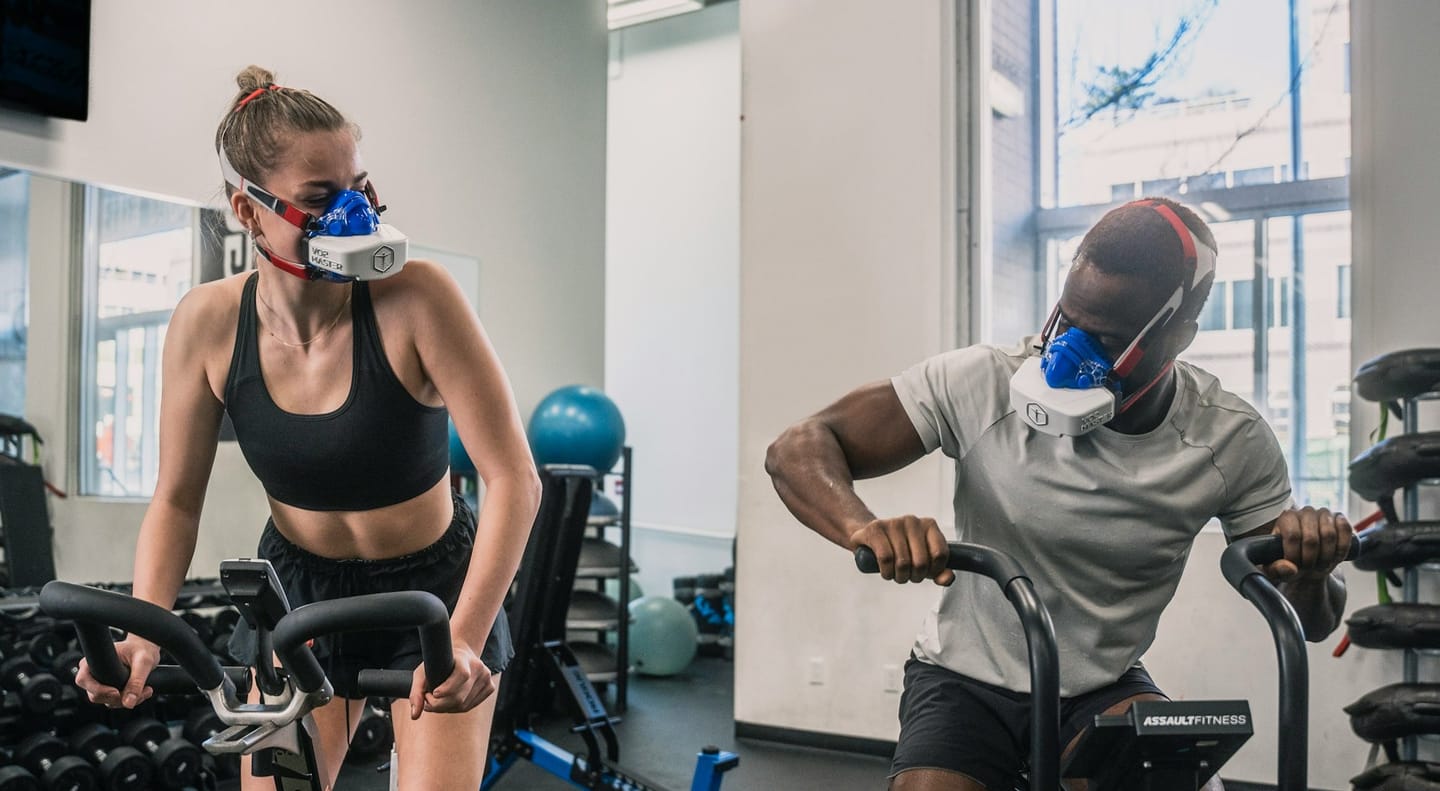
A maximal exercise test with a metabolic cart, performed in a sports science lab or university facility, is the most accurate measurement available. You exercise on a treadmill or cycle ergometer at progressively increasing intensities while wearing a mask that measures respiratory gases (oxygen consumed and CO2 produced). The test continues to exhaustion.
This produces not just VO2 max but a complete metabolic profile: VT1 (first ventilatory threshold, roughly Zone 2 upper boundary), VT2 (second ventilatory threshold, roughly lactate threshold / critical power), and the entire oxygen consumption curve across intensities.
For a triathlete investing seriously in training, a full lab test every 12–18 months is arguably the most information-dense physiological assessment available. The cost is typically £150–300 depending on the facility.
Lactate Step Testing (Near Gold Standard)
A structured field or lab test using incremental exercise stages with fingertip blood lactate sampling at each step. This doesn't directly measure VO2 max but provides extremely accurate threshold data and can estimate VO2 max via validated protocols.
More accessible than a metabolic cart test for most athletes. Offered by many coaching facilities and physiologists. Also gives the Zone 2 upper boundary (1.7–2.0 mmol/L) and lactate threshold point with precision.
Field Testing Protocols
Several validated field tests provide reliable VO2 max estimates without lab equipment:
Cooper 12-Minute Run Test: run as far as possible in 12 minutes on a flat, measured surface. VO2 max (mL/kg/min) ≈ (distance in metres − 504.9) ÷ 44.73. Reasonably accurate in trained athletes who can pace themselves appropriately.
5-Minute Maximal Effort (Cycling): a 5-minute all-out effort on the bike. Average power divided by body weight, then multiplied by a conversion factor (approximately 10.8 for trained athletes, + 7) gives an estimated VO2 max. Requires a power meter.
Ramp Test: commonly used on smart trainers. Power increases by a fixed amount (typically 20–25W) every minute until failure. VO2 max is estimated from peak 1-minute power output. Widely used and reasonably accurate, though it slightly favours athletes with high anaerobic capacity.
Wearable Estimates
Garmin, Polar, Apple Watch, and most modern training platforms provide VO2 max estimates derived from heart rate and pace or power data during submaximal exercise. These are useful for tracking trends over time, improving VO2 max estimates across weeks and months is a meaningful signal, but they are not direct measurements and can be substantially off in absolute terms.
Treat wearable VO2 max scores as a relative tracking tool, not an absolute physiological value. Use them to confirm direction of adaptation, not to benchmark against population norms.
What Determines Your VO2 Max?
Genetics accounts for approximately 40–50% of VO2 max variance between individuals. This includes cardiac morphology, muscle fibre type distribution, and haemoglobin concentration. You cannot train your way to a VO2 max of 85 if your genetic ceiling is 70, but you can almost certainly get considerably closer to your ceiling than you currently are.
Training history and current training load account for the trainable component. VO2 max is highly responsive to training in untrained and moderately trained individuals and somewhat less responsive in already highly trained athletes. This is the phenomenon of diminishing returns: early in your training career, VO2 max improvements come readily; at elite level, each additional mL/kg/min requires disproportionate training investment.
Body composition affects the score via the per-kilogram denominator. Losing excess body fat raises VO2 max even without any cardiovascular adaptation, the same absolute oxygen consumption capacity is divided by a smaller number. This is one reason VO2 max scores are expressed per kilogram and why weight management has a measurable impact on the metric.
Age reduces VO2 max by approximately 1% per year after peak (typically mid-to-late 20s), driven largely by declining maximal heart rate. This decline is substantially attenuated by continued training, masters athletes who maintain high training loads retain significantly higher VO2 max than sedentary peers of the same age.
How to Improve VO2 Max
VO2 max responds best to training at or very close to VO2 max intensity, roughly 95–100% of maximal heart rate, or the power/pace you can sustain for approximately 5–8 minutes maximally. This is what most training systems label Zone 5 or the upper end of Zone 4.
The principal training methods:
VO2 Max Intervals (4–8 Minutes)
The most well-evidenced method. Work intervals of 4–8 minutes at VO2 max intensity (roughly 95–100% HRmax, or your best 5–8 minute pace/power), with recovery intervals of equal or slightly shorter duration.
Classic protocol: 4–6 × 4 minutes at VO2 max intensity, 3–4 minutes easy recovery. Originally from the work of Tabata and Helgerud, this structure consistently produces measurable VO2 max improvements in trained athletes.
The key is accumulating enough time at or near VO2 max intensity, research suggests a minimum of 10–15 minutes per session at target intensity is needed for a meaningful stimulus.
Example cycling session:
- 15 min warm-up at Zone 2
- 5 × 4 min at 110–120% FTP (VO2 max zone), 4 min easy between each
- 10 min cool-down
Example run session:
- 15 min easy warm-up
- 4 × 5 min at best 3 km pace, 4 min walk/jog recovery
- 10 min cool-down
Short Interval Training (30/30s, Norwegian Method Variants)
Very short efforts at maximal intensity with brief recoveries can also drive VO2 max adaptation. The 30-second on / 30-second off format popularised through Norwegian training research produces high cumulative time near VO2 max with lower perceived exertion per interval, athletes can sustain the format longer than longer blocks.
This approach has gained particular attention in triathlon communities following its use by professional triathletes training under Olav Aleksander Bu.
Example run session:
- 15 min warm-up
- 20–30 × 30 sec at 3 km effort, 30 sec easy jog
- 10 min cool-down
Long Aerobic Volume (Zone 2)
Zone 2 training does not directly target VO2 max, but it provides the aerobic infrastructure that VO2 max intervals build on. More mitochondria, greater capillary density, and higher cardiac stroke volume, all Zone 2 adaptations, raise the adaptive ceiling for VO2 max work. Athletes who neglect aerobic base and do only high-intensity intervals find VO2 max gains plateau quickly, because the peripheral utilisation side of the equation remains underdeveloped.
The interaction is bidirectional: Zone 2 builds the base, VO2 max intervals push the ceiling, and each makes the other more effective.
Training Frequency and Recovery
VO2 max intervals generate significant neuromuscular and metabolic fatigue. Most trained athletes can sustain one, at most two, quality VO2 max sessions per week per sport without compromising recovery. In triathlon, where total training load is distributed across three sports, this means programming VO2 max work carefully, typically in one discipline per week during build phase, rotating over the training block.
VO2 Max in Triathlon Context
For triathlon, VO2 max data is most actionable in the sport where your performance is most limited. If swimming is your limiter, VO2 max intervals in the pool are unlikely to be the lever, technique and threshold are. If cycling is the limiter, targeted VO2 max work on the bike during the build phase will pay a higher dividend than equivalent run work.
In race execution, VO2 max intensity is only briefly relevant, start line effort in the swim, surges on technical bike courses, and final run efforts. The majority of long-course triathlon is executed well below VO2 max. But your VO2 max determines the size of the engine, the higher your ceiling, the more comfortable and efficient everything below it becomes.
This is why both VO2 max training and Zone 2 training are essential: Zone 2 determines how efficiently you cruise; VO2 max determines how high that cruise can go before you're working maximally.
Tracking VO2 Max Over Time
Test consistently using the same protocol. If you use a lab test, retest at the same lab under comparable conditions (hydration, fatigue state, time of day). If you use field tests, replicate conditions as precisely as possible.
Meaningful VO2 max improvement in trained athletes over a 12-week block: 3–6% is a realistic target. Greater gains are possible in less trained athletes or after a structured base-building phase. If you are seeing no change after 12 weeks of structured training, the most likely causes are insufficient training load, inadequate Zone 2 volume underpinning the intensity work, or insufficient recovery between sessions.
Key Takeaways
- VO2 max is the ceiling of your aerobic system, set by cardiac output and muscular oxygen utilisation
- It predicts performance across populations but not reliably within a trained peer group
- Lactate threshold and efficiency are the primary performance discriminators among trained athletes with similar VO2 max
- Lab testing is most accurate; wearable estimates are useful for tracking trends
- VO2 max intervals (4–8 min at maximal aerobic intensity) are the most direct training stimulus
- Zone 2 builds the aerobic foundation that makes VO2 max training more effective
- In long-course triathlon, VO2 max sets your ceiling, but racing happens well below it