
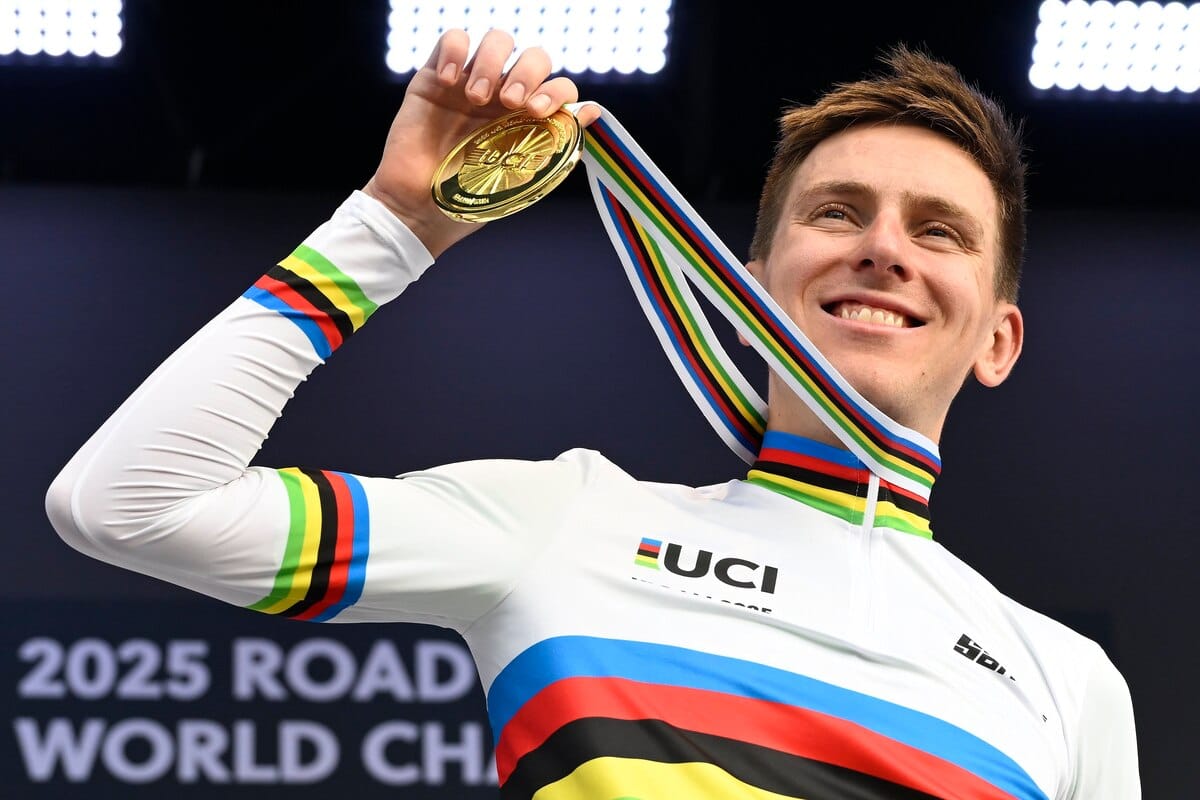
Tadej Pogačar has confirmed a 2026 racing programme that prioritises performance specificity over volume, with two clear objectives anchoring the season: a first victory at Paris-Roubaix and a potential fifth Tour de France title. Rather than chasing wins across an overloaded calendar, the plan reflects a controlled approach to peak performance across the sport’s most demanding physiological and tactical extremes.
For UAE Team Emirates-XRG, the message is clear. This is not a season designed around opportunistic racing. It is a season engineered around two problems to solve.
Why Paris-Roubaix Matters
Paris-Roubaix remains one of the few major races missing from Pogačar’s palmarès. More importantly, it represents a performance challenge unlike anything else on the calendar. High torque demands, repeated neuromuscular fatigue, technical bike handling under stress, and chaotic race dynamics make Roubaix less predictable than other Monuments.
Pogačar’s recent editions showed that he is not limited by the cobbles themselves, but by the narrow margins that define success in Roubaix: positioning, timing, and resilience after cumulative load. His continued focus on the race suggests that Roubaix is viewed internally not as a gamble, but as a solvable performance equation.
From a Triforge perspective, targeting Roubaix alongside the Tour signals confidence in durability, power repeatability, and recovery efficiency - traits that sit at the intersection of one-day racing and Grand Tour dominance.
A Monument-Heavy Spring, by Design
The confirmed spring programme includes Strade Bianche, Milan-San Remo, Tour of Flanders, Paris-Roubaix, and Liège-Bastogne-Liège. This sequence is not about chasing every result, but about maintaining race intensity while progressively stressing different physiological systems.
Each race serves a purpose:
- Strade Bianche and Flanders test sustained power and positioning
- San Remo rewards tactical patience and anaerobic sharpness
- Roubaix pushes durability and mechanical resilience
- Liège reinforces climbing efficiency and fatigue resistance
Rather than fragmenting form, the block builds a broad but controlled performance base before transitioning toward stage racing.
The Shift Toward July
After the Classics, Pogačar will pivot toward stage races such as Romandie and Tour de Suisse, using them as calibration rather than peak objectives. These races offer controlled exposure to climbing load, time-trial stress, and recovery cycles without the full strain of a Grand Tour.
A Tour de France win in 2026 would bring Pogačar to five overall victories, a threshold reached by only a handful of riders in history. While the milestone is historic, the framing from the rider and team suggests that the goal is less about numbers and more about sustained dominance across eras and race types.
Team Structure and Load Management
UAE Team Emirates-XRG will approach 2026 with a slightly redistributed leadership model. João Almeida is expected to focus on other Grand Tours, allowing the Tour squad to integrate younger riders into high-responsibility roles. This shift reduces internal competition for GC leadership while increasing tactical flexibility around Pogačar.
From a performance standpoint, this also enables better load management across the season, limiting burnout risk while preserving peak capacity for July.
A Season Built Around Legacy, Not Accumulation
What stands out in Pogačar’s 2026 plan is restraint. There is no attempt to race everywhere, no inflated calendar, and no chase for marginal wins. Instead, the structure reflects a rider operating from a position of control, choosing races that matter because they test something fundamental.
Paris-Roubaix and the Tour de France sit at opposite ends of the performance spectrum. Targeting both in the same season is not common, and rarely successful. But for Pogačar, that dual focus appears intentional.