

You don't burn out from training too hard. You burn out from training too hard relative to what your body can absorb.
That distinction matters more than most athletes realise. The endurance athletes who stay healthy and keep improving year after year aren't necessarily doing the least work, they're managing the relationship between training stress and recovery with deliberate precision. Training load management is the framework that makes that possible, and it's the single most underleveraged tool available to age-group triathletes, cyclists, and runners who want to perform at their ceiling without repeatedly hitting the floor.
What Is Training Load?
Training load is a quantified measure of the total physiological stress placed on your body over a given period. It's the product of two variables: intensity (how hard you train) and volume (how much you train). Neither alone tells the full story.
A single all-out 5K effort and a steady 90-minute zone 2 run might feel similarly demanding in the moment, but they impose fundamentally different stresses on your body, recover at different rates, and drive different physiological adaptations. Training load quantifies that difference in a way that raw distance and time simply cannot.
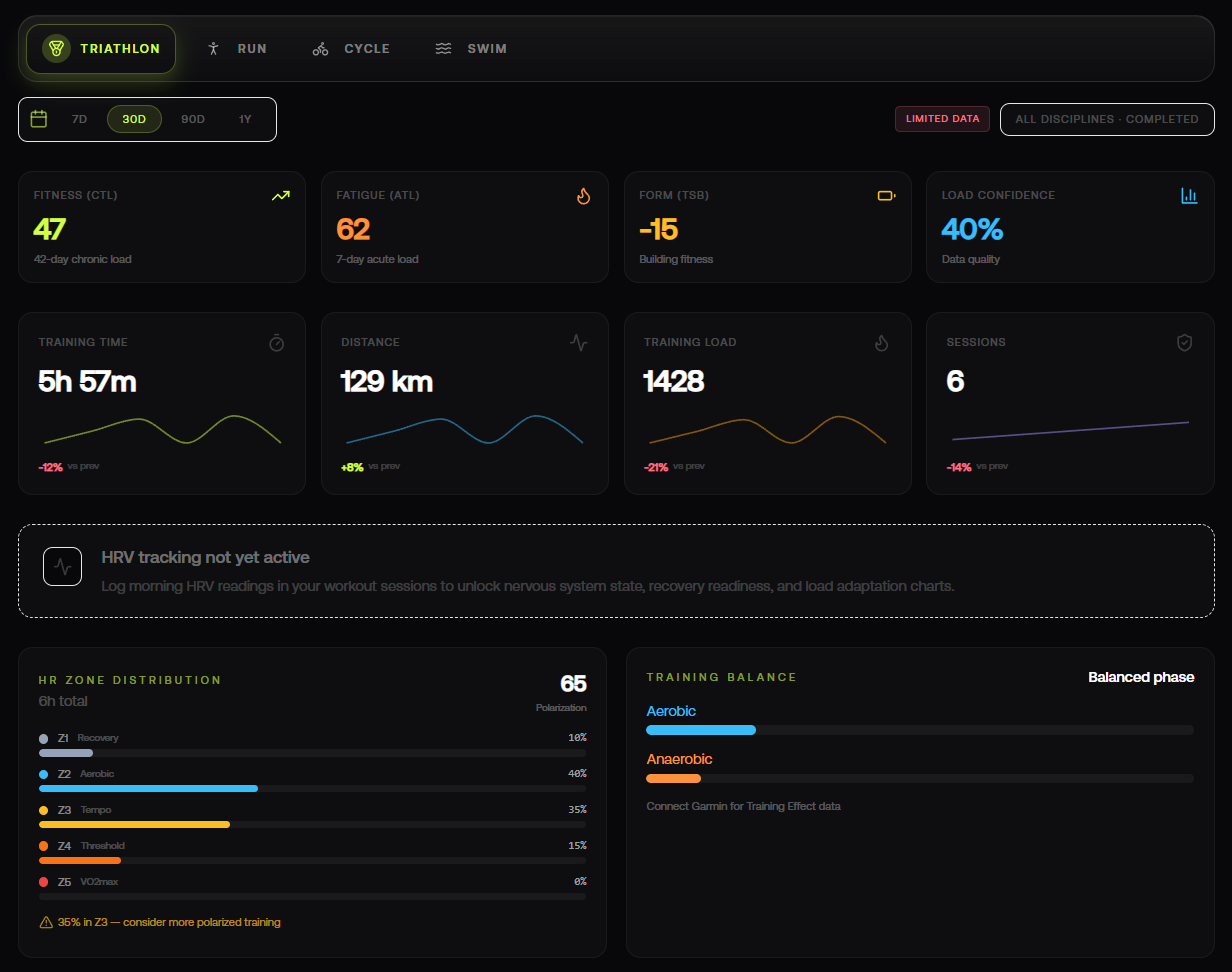
Most modern training platforms, and Triforge, represent load using three rolling metrics derived from the foundational work of Dr. Andrew Coggan and Hunter Allen:
Acute Training Load (ATL) is the training stress accumulated over the past 7 days. It's a rolling measure of recent fatigue that rises quickly when you train hard and drops equally fast when you back off. Think of ATL as the debt side of the ledger.
Chronic Training Load (CTL) is the stress accumulated over the past 42 days. It moves slowly by design, and it's the closest objective proxy you have for your current fitness base. Think of CTL as the equity side, what you've actually built.
Training Stress Balance (TSB) is the difference between CTL and ATL. When TSB is negative, you're carrying more fatigue than your fitness can comfortably absorb. When it's positive, you're fresh, and if CTL is high, likely primed to perform.
These aren't abstract numbers. They're a real-time map of where you sit on the fitness-fatigue curve, and they tell you things your perceived effort cannot.
Why Most Athletes Ignore Training Load — And What They Use Instead
Most recreational athletes track distance and time. Ten hours of training this week feels like meaningful data. It is, but it's an incomplete picture.
Two athletes can log identical weekly hours and produce entirely different physiological outcomes depending on intensity distribution, accumulated fatigue, sleep quality, life stress, and training history. Volume is an input. It tells you how long you were moving. It doesn't tell you how much stress you generated, how much recovery that stress demands, or whether the sessions you completed are translating into fitness or breakdown.
Training stress score (TSS), the per-session load metric that feeds into ATL and CTL, solves this by combining duration and intensity into a single number that accounts for both. A 60-minute easy ride might generate 40–50 TSS. A 60-minute threshold interval session in the same time window might generate 80–100 TSS. Logging both as "one hour of cycling" treats them as equivalent. They are not.
Triforge tracks TSS across swim, bike, and run automatically via Strava integration, so your ATL, CTL, and TSB update in real time without requiring manual entry. The load picture stays accurate even when your week doesn't go to plan.
The Ramp Rate Problem: Why Fit Athletes Still Get Injured
If there's a single concept that explains the majority of overtraining injuries in endurance sport, it's ramp rate, the speed at which training load increases week over week.
The commonly cited guideline is the 10% rule: don't increase weekly volume by more than 10% compared to the prior week. Like most training rules of thumb, it has some merit and significant limitations. It accounts for volume but ignores intensity, cumulative fatigue, and your current fitness baseline.
A more precise framework is the acute-to-chronic workload ratio (ACWR), your ATL divided by your CTL. Research across team sports and endurance disciplines consistently shows that injury risk rises sharply when ACWR exceeds approximately 1.5, meaning your recent training week is roughly 50% harder than your rolling 6-week average. Below 1.3, the risk profile remains relatively low.
The practical implication cuts both ways:
- High CTL = larger buffer. If you've been training consistently for months, your chronic load is elevated, meaning you can absorb larger acute spikes before crossing into the danger zone. Fitness is protective.
- Low CTL = narrow margin. An athlete returning from a rest week, illness, or off-season has a depressed CTL. They may feel capable of jumping back into hard training, and subjectively, they might feel fine, but their ACWR can tip dangerous almost immediately. This is the mechanism behind most early-season injuries.
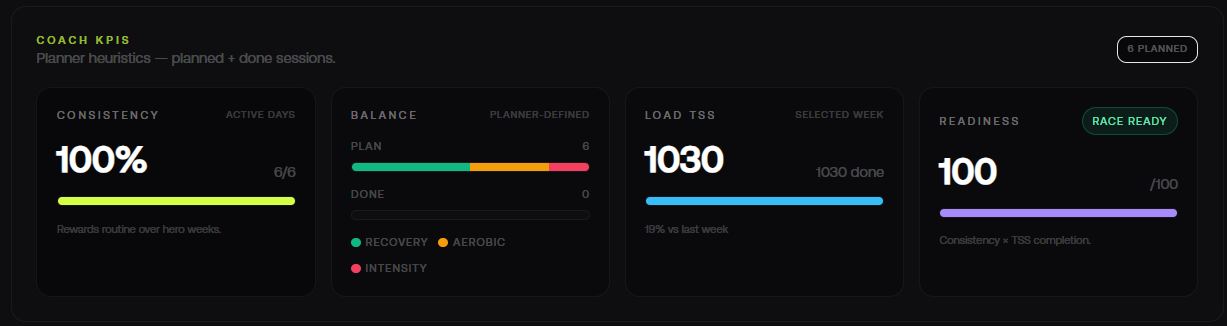
Monitoring your ACWR is one of the core functions Triforge performs. Rather than guessing whether your week was too hard relative to your baseline, the platform surfaces the ratio directly so you can adjust before problems compound.
Hard Weeks Require Easy Weeks — Without Exception
Progressive overload, systematically increasing training stress to drive adaptation, only functions when recovery is structurally embedded into the programme. Stress without recovery doesn't produce fitness. It produces breakdown.
The classic three-to-one periodization model structures training in four-week blocks: three weeks of gradually increasing load followed by one reduced week at approximately 60–70% of peak volume. That reduced week isn't a reward for hard work. It's a biological requirement for the adaptation cycle to complete.
Physiological adaptation doesn't happen during the hard session. It happens in the 48 to 72 hours after, when the body repairs and reinforces the systems that were stressed:
- Satellite cells rebuild muscle fibres fractionally stronger
- Mitochondrial density increases in slow-twitch fibres
- Capillary networks expand to improve oxygen delivery
- Tendons and connective tissue remodel to handle repeated load
All of this requires time, nutritional support, and reduced training demand. Miss the recovery week consistently, and fatigue accumulates faster than fitness. CTL stagnates. TSB becomes chronically negative. Performance deteriorates even as training volume rises, and athletes often respond by adding more work, accelerating the problem.
The paradox of endurance performance: the athletes who recover best improve fastest, not because they're doing less, but because the work they do is actually landing.
Intensity Distribution: The Hidden Driver of Training Load
A common and costly mistake among self-coached athletes is letting easy sessions drift too hard. When most training happens at moderate effort, not quite easy, not quite intense, the physiological signal is blunted, recovery cost rises, and the adaptive return diminishes.
The polarised training model, supported by decades of research including the foundational work of exercise physiologist Dr. Stephen Seiler, finds that elite endurance athletes distribute their training time roughly as follows:
- ~80% at genuinely low intensity: below the first lactate threshold, conversational effort, zone 1–2
- ~20% at genuinely high intensity: above the second lactate threshold, zone 4–5, where lactate accumulates rapidly
- Very little in the middle: tempo and threshold effort used sparingly, not as the default
This isn't because moderate-intensity training is worthless. It's because chronic accumulation of moderate-intensity load generates substantial fatigue while delivering a blunted adaptive stimulus compared to true high-intensity work. The result is an athlete stuck in the "grey zone" a persistent low-level fatigue state that masquerades as consistent training while quietly eroding performance ceiling.
Understanding intensity distribution changes how you think about training load entirely. A week of 80/20 training and a week of all-moderate training can look identical in total hours while producing very different ATL values, different recovery demands, and different fitness outcomes.
For a precise look at where the lactate thresholds sit physiologically and how to train around them effectively, see [Lactate Threshold Training: What It Is and How to Use It].
Training Load Management in Triathlon: The Multi-Sport Complexity
Triathlon adds a layer of load complexity that single-sport athletes don't face: three disciplines with different musculoskeletal demands, different injury risk profiles, and different recovery timescales, stacked on top of each other across the same training week.
A long ride the day before a hard run session represents a different load equation than either in isolation. The cumulative TSS from swim, bike, and run across a seven-day period is not simply the arithmetic sum of its parts. Transitioning between disciplines imposes additional metabolic and neuromuscular cost. Running on pre-fatigued legs from a hard bike session generates substantially higher musculoskeletal stress than running fresh, at the same pace, with the same heart rate, generating more tissue damage.
For triathletes, effective load management requires thinking in cross-sport weekly totals while also considering the sequence of training:
- A hard bike followed by a run brick amplifies the cumulative stress of both sessions
- A recovery swim after a long ride accelerates systemic recovery in a way a second run session would not
- Back-to-back high-TSS days in any combination compress the recovery window available before the next quality session
Triforge accounts for this multi-sport reality by aggregating TSS across all three disciplines via your connected Strava data. Your ATL, CTL, and TSB reflect your true combined load, not just your run volume or your bike hours in isolation, giving you an accurate picture of where you actually sit on the fatigue curve heading into each session.
Practical Signals That Your Load Is Off
You don't need a dashboard to notice when load management is breaking down. The body communicates clearly. Most athletes know something is wrong before they look at any data, they just don't always know what the signal means.
Paces and power feel harder for the same outputs. Sessions that used to feel controlled now require disproportionate effort. You're working harder for slower results. This is the functional definition of fitness-to-fatigue imbalance.
Sleep quality deteriorates despite physical tiredness. Elevated sympathetic nervous system activity from chronic overreaching disrupts sleep architecture even when physical exhaustion is high. Sleeping badly while feeling wrecked is frequently a training load signal rather than a lifestyle one.
Motivation drops in a way that feels qualitatively different from normal training resistance. Not the expected reluctance before a hard Tuesday session, a more pervasive flatness toward training that used to generate genuine anticipation. This psychological component is among the hardest to reverse once established.
Resting heart rate is consistently elevated. Three to five beats per minute above your established morning baseline across several consecutive days is one of the more reliable physiological markers of accumulated systemic fatigue. Measure it first thing in the morning, before caffeine or movement.
Performance regresses despite increased effort. More training is producing less output. That's the clearest functional definition of an unproductive training cycle, and the most common trigger for athletes to make things worse by adding volume.
None of these signals requires a clinical diagnosis. Each one is an invitation to reduce load, prioritise sleep, and allow the adaptation you've been accumulating to surface.
How to Manage Training Load Without Becoming a Data Scientist
The principles that matter most are also the most straightforward. You don't need to spend hours inside a training analytics dashboard to apply them.
Track TSS consistently. Whether you're using Triforge, TrainingPeaks, or a manual log, having a consistent load metric gives you a baseline to compare against. The absolute numbers matter less than the trend. If your rolling load is rising without a scheduled reduction week, that alone is enough signal.
Keep easy days genuinely easy. If your aerobic base sessions regularly push into zone 3, moderate effort where conversation requires some though, your load is higher than your log suggests and your recovery is slower than you think. The most impactful single adjustment most self-coached athletes can make is slowing down on days designated as easy. Seriously.
Schedule your reduced weeks before the block begins. Don't wait until you're broken or unmotivated to reduce load. Build recovery weeks into your training block structure before the block starts, and protect them with the same discipline you'd apply to a race-day schedule.
Learn to distinguish fatigue types. Acute fatigue from a hard session is expected, healthy, and transient, it resolves in 24 to 48 hours with good sleep and nutrition. Chronic fatigue that compounds across weeks without a recovery phase is the problem. Learn how each one feels, and respond accordingly rather than treating all tiredness as something to push through.
Factor life stress into your load ceiling. Training stress doesn't exist in a vacuum. A week of poor sleep, significant travel, high work pressure, or personal stress dramatically reduces your capacity to absorb training, even if the sessions on paper look manageable. Your effective load ceiling drops whether your training plan accounts for it or not. The most self-aware athletes treat these variables as genuine inputs to their load calculation, not excuses.
Frequently Asked Questions About Training Load
What is a good TSS per week for a triathlete? It depends heavily on training history, event distance, and time of season. Recreational sprint and Olympic triathletes typically sustain 300–500 weekly TSS during build phases. Half and full-distance athletes in peak training may reach 600–900+ TSS per week. More important than the absolute number is the rate of change, keeping ACWR below 1.3–1.5 regardless of your baseline.
How quickly does fitness (CTL) drop during a rest week? CTL decays at approximately 2% per day. A genuine rest week will drop your CTL by 10–15 points, which is normal and expected. ATL drops faster, which is why TSB turns positive quickly after reduced load, that's the freshness signal you want heading into a target race or a high-quality training block.
Is the 10% rule still useful? As a rough guardrail, yes. As a precision tool, no. The ACWR is more informative because it accounts for your fitness base, not just last week's volume. A 20% volume increase may be perfectly safe for an athlete with high CTL; a 5% increase may tip an undertrained athlete into the danger zone.
Does Triforge track training load automatically? Yes. Triforge pulls your swim, bike, and run data from Strava and calculates ATL, CTL, TSB, and per-session TSS automatically. You don't need to manually log sessions or configure thresholds, the load picture updates in real time as your training syncs.
The Bigger Picture
Training load management isn't about training less. It's about training productively, accumulating fitness at a rate your body can consolidate without tipping into breakdown, overreaching, or the slow-building fatigue that eventually forces unplanned rest.
The athletes who stay consistent across years tend to outperform those who alternate between heroic training blocks and forced recovery from injury or burnout. Consistency is the compounding engine of endurance performance. Load management is what protects it.
The framework is simple even when execution is hard: build load progressively, distribute intensity intelligently, recover on schedule, and learn to read your body's signals before they become injuries or extended setbacks.
Train hard. Recover harder. Know the difference between the two, and have the data to prove it.