
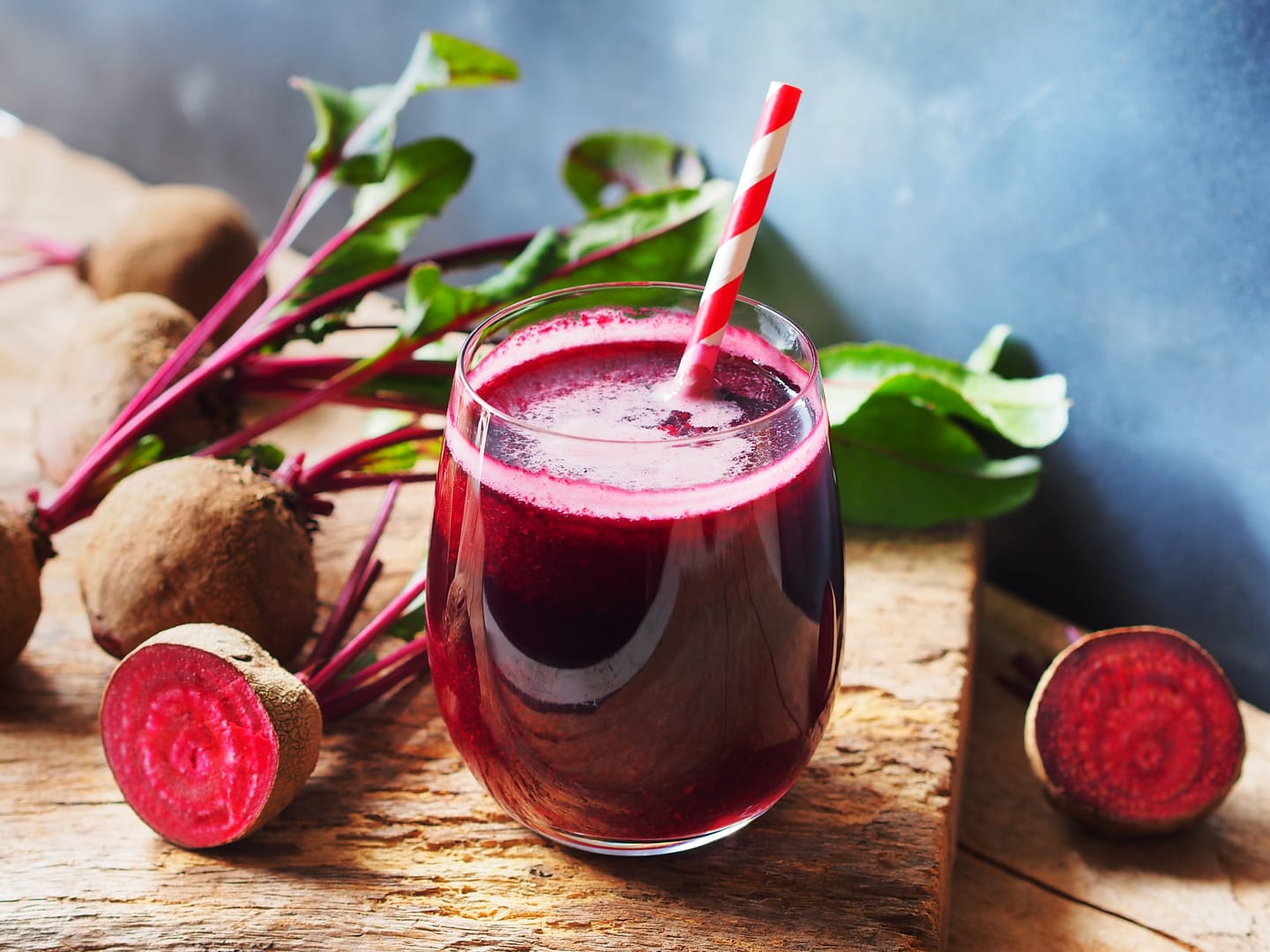
Beetroot juice is one of the most-researched ergogenic aids in endurance sport. Walk through the expo at any major triathlon and you'll find a dozen brands claiming it will "elevate your VO2 max" and "unlock your aerobic ceiling." The marketing is loud. The science is more nuanced, and considerably more interesting.
The short answer: dietary nitrates don't meaningfully raise your VO2 max. What they do is make the oxygen you already have go further. For competitive age-groupers, that distinction matters enormously for how you use this supplement and what you can realistically expect from it.
The Nitrate-Nitric Oxide Pathway
Inorganic nitrate (NO₃⁻) is found in high concentrations in beetroot, spinach, rocket, and celery. When you consume it, oral bacteria on the tongue reduce it to nitrite (NO₂⁻), which then enters the bloodstream and is converted, particularly in low-oxygen conditions, to nitric oxide (NO).
Nitric oxide is the active agent. It is a powerful signalling molecule involved in vasodilation, mitochondrial respiration regulation, and skeletal muscle contractile function. The key mechanisms relevant to endurance performance are:
Vasodilation and blood flow. NO relaxes smooth muscle in blood vessel walls, widening the vessels and increasing oxygen delivery to working muscle. This is the mechanism most people have heard of, and it's real, but it's downstream of where the biggest gains come from.
Mitochondrial efficiency. The more impactful mechanism is NO's effect on mitochondrial respiration. Specifically, nitrates reduce the oxygen cost of producing a given amount of ATP. Put differently: your muscles can generate the same power output while consuming less oxygen. This is often described as improved exercise economy.
Type II muscle fibre function. Nitrates appear to enhance calcium handling and contractile efficiency in fast-twitch fibres, relevant for repeated hard efforts, surges, and short climbs during racing.
The discovery that launched the field was a 2007 paper by Larsen and colleagues, who found that sodium nitrate reduced the oxygen cost of submaximal cycling. Beetroot juice was subsequently shown to deliver the same benefit through the same pathway, and the research has been building ever since.
What the Evidence Actually Shows
Time to Exhaustion: Clear Benefit
The strongest and most consistent finding across the literature is that nitrate supplementation extends time to exhaustion. An umbrella review published in Sports Medicine in March 2025, covering 20 systematic reviews with meta-analyses and 2,672 unique participants, found that nitrate supplementation significantly improved time-to-exhaustion performance (SMD: 0.33; 95% CI 0.19–0.47). PubMed Central A standardised mean difference of 0.33 represents a small-to-moderate effect, meaningful in competition, where the margins between age-group podium positions are tight.
Time Trials: Small but Present
Race-specific performance is harder to improve. A systematic review and meta-analysis examining high-intensity time-trial performance found an overall trivial effect in favour of nitrate (Hedges' g = 0.15), with subgroup analysis suggesting a small, borderline benefit specifically for chronic supplementation protocols. PubMed Central A 1–2% improvement in a 40-minute bike split is not trivial, but it's not the transformative result some marketing would have you expect.
VO2 Max: Modest, Mostly in Recreationally Trained Athletes
Here is where the marketing diverges most sharply from the data. A 2025 umbrella review covering 15 meta-analyses found that beetroot juice significantly improved VO2 max in healthy adults (SMD = 0.16, p = 0.033), but the effect size was small. PubMed Central That SMD of 0.16 is near the lower threshold of practical significance. More importantly, the benefit was concentrated in recreationally trained individuals, not competitive athletes.
Results in elite athletes are mixed, likely because highly trained individuals have already optimised their nitric oxide utilisation through years of high-volume training, leaving less room for nitrate supplementation to produce a measurable effect. MDPI
If you're a 4:30 Ironman athlete training 15+ hours per week, you should not expect beetroot juice to meaningfully lift your VO2 max. What it may do, and this is the more accurate value proposition, is improve your efficiency at sub-maximal intensities, which has real-world implications for pacing, perceived exertion, and late-race performance.
Training Status: The Most Important Variable
The training-status interaction is the single most important factor in predicting whether nitrate supplementation will benefit a given athlete. The mechanistic explanation is straightforward: trained athletes already have elevated NO production, better vascular function, and higher mitochondrial density than untrained individuals. Nitrates deliver their gains through the same pathways that training itself optimises.
This doesn't mean elite athletes get nothing. Research on highly trained cyclists and triathletes has shown small but consistent improvements in oxygen economy at threshold intensities, which is exactly where long-course athletes spend most of their race. The effect on raw VO2 max may be negligible; the effect on sustainable power at a given fraction of VO2 max may still be useful.
For age-groupers training 8–15 hours per week, you likely sit in the middle of this spectrum. Some benefit is plausible, particularly for time-to-exhaustion and sub-threshold efficiency. Don't expect to see your VO2 max score jump on your next fitness test.
Dosing and Timing
Research suggests a potential saturation point for the NO₃⁻ → NO₂⁻ → NO pathway at approximately 12 mmol of nitrate, with plasma nitrite levels not increasing further beyond this dose. Springer Most commercial beetroot juice concentrates deliver 5–8 mmol per serving (roughly 70 ml). Doubling your dose beyond 12 mmol appears to offer diminishing returns and potentially none at all.
Timing matters significantly. The conversion of nitrate to nitric oxide is not instant. Standard research protocols deliver 50 ml of beetroot juice concentrate (approximately 6.2 mmol nitrate) roughly two and a half hours before exercise. PubMed Central Peak plasma nitrite concentrations occur around 2–3 hours post-ingestion. Taking your shot 20 minutes before your race starts is a common mistake that leaves most of the pharmacokinetic benefit on the table.
Practical dosing guidelines for competitive athletes:
- Dose: 5–8 mmol of nitrate (~70–140 ml concentrate, 300–500 ml whole juice), or whole-food equivalent
- Timing: 2–3 hours pre-exercise
- Protocol: Acute use before key sessions or races; some evidence supports chronic loading (daily use for 3+ days) for slightly greater effect, particularly on time-trial performance
- Avoid mouthwash on the day of supplementation, antibacterial mouthwash kills the oral bacteria responsible for converting nitrate to nitrite, eliminating the entire pathway
Whole Beetroot vs. Juice vs. Concentrate
Not all nitrate sources are created equal. Beetroot juice concentrate (the "shots" sold by brands like Beet It) offers the most studied and dose-controllable format. Beetroot's liquid form facilitates precise dose determination and manipulation under controlled conditions, and its rapid absorption and predictable pharmacokinetics make it preferable to powders, gels, or capsules in research settings. MDPI
That doesn't mean powder and capsule forms are ineffective, they simply carry more variability in nitrate content and absorption rate. If you use a non-liquid format, check the standardised nitrate content on the label, not just the beetroot extract dose.
Spinach, rocket, and celery are naturally high-nitrate whole foods and represent a viable dietary approach for athletes who prefer to avoid supplements. The challenge is dose consistency: nitrate content in vegetables varies substantially by growing conditions, storage, and preparation method. For pre-race precision, the concentrate wins.
The Oxygen Efficiency Framing
The more honest, and ultimately more useful, way to think about nitrates is this: they don't raise your aerobic ceiling; they allow you to work closer to it with lower oxygen cost.
In practical terms, this means:
- At threshold pace, your perceived exertion may be slightly lower
- You may be able to sustain a given pace longer before accumulating fatigue
- Your efficiency during the final third of a long race, when oxygen debt compounds, may be marginally better
None of this appears dramatically on a VO2 max test. But spread across a 5-hour Ironman 70.3 bike-run, even small improvements in sub-threshold economy compound into meaningful time savings.
This is why the time-to-exhaustion data is the most relevant number for long-course triathletes, not the VO2 max SMD. The question isn't whether your ceiling rises, it's whether you can sustain effort closer to that ceiling, longer.
Practical Takeaways for Age-Group Athletes
Dietary nitrates are among the few ergogenic supplements with a legitimate evidence base. They are not a shortcut to a higher VO2 max, but they are a credible tool for improving oxygen economy and extending high-intensity endurance.
If you're going to use them intelligently:
- Time correctly. Two to three hours pre-exercise, not immediately before the start.
- Dose accurately. Target 5–8 mmol of nitrate. Don't assume more is better beyond 12 mmol.
- Skip the mouthwash. Antibacterial products on race morning will undo the entire mechanism.
- Calibrate expectations to your training status. The higher your fitness, the smaller the likely VO2 max effect, but oxygen economy benefits may still apply at your race intensities.
- Consider chronic loading for A-race priority events: 3–6 days of daily supplementation may yield slightly greater time-trial benefits than single acute doses.
The question "does beetroot boost VO2 max?" gets a qualified no. The better question is: "does beetroot improve how efficiently I use the VO2 max I've earned through training?" On that, the evidence says yes, modestly, reliably, and mechanistically soundly.